Chesterfield
Mariners' Museum, Uncurated Search Results
Type: Schooner
Year: 1878
Builder: Kirby & Lang
Location:

These records are found in the online catalog of The Mariners’ Museum and Park in Newport News, Virginia. Uncurated search results are presented to give researchers and interested readers an idea of whether the museum’s archives contain information about this vessel and whether it may be worthwhile to visit the museum’s catalog search page for further investigation. Uncurated results may be inaccurate or incomplete.
Search mode: Exact Name. Search phrase(s): "Chesterfield". Results returned: 34. Results displayed in this table: 34.
Use these buttons to send uncurated search results to your own app or text document for further research. First, check the box for any row, or click "Select All" then uncheck any rows. Then click "Show Selections". You can then copy your selections from the text box and past them into your app.
| Fetch? | Row ID | Media | Date | Vessel | Place | Related Places | Inscription/Marks | Subject | Notes | Archive Number |
|---|---|---|---|---|---|---|---|---|---|---|
| 1 | No image URL. | Chesterfield | P0001.011/01-0605 | |||||||
| 2 | No image URL. | Education–Virginia–Chesterfield County; Schools–Virginia–Chesterfield County | Nineteenth-century education in western Chesterfield County | LB104443 | ||||||
| 3 | No image URL. | 10/1948 | Robert L. Webster (Sloop : 1915). | Deal Island (Md.). | View of two vessels tied up in Deals Island harbor, Maryland. Skipjack Robert L. Webster is in the foreground and schooner Chesterfield is behind her. | P0001.011/01-#PK1196 | ||||
| 4 | 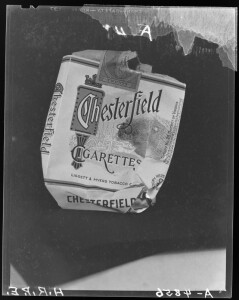 | 10/22/1943 | Fingerprints.; Cigarettes–Packaging–Virginia–Newport News. | Close-up of a fingerprint on the front of a pack of Chesterfield Cigarettes. | P0003/01-#A-4856 | |||||
| 5 | No image URL. | Railroads–Virginia. | Narrow gauge to Farmville : __its line was not very long, but the Tidewater and Western was important in Chesterfield. | LB79392 | ||||||
| 6 | No image URL. | Chesterfield Railroad Company | Coal mines and mining–Virginia–Chesterfield County. | Forerunner of Virginia's first railway : __a thirteen-mile tramway connected the James River with Chesterfield County's coal pits | LB103793 | |||||
| 7 | No image URL. | Historic buildings–Virginia.; Courthouses–Virginia–Henrico County; Courthouses–Virginia–Chesterfield County | Courthouses of Henrico and Chesterfield : __the twin colonial buildings have been replaced, but the functions of local government continue | LB103591 | ||||||
| 8 | No image URL. | Coal mines and mining–Virginia–Chesterfield County. | Mines of Midlothian : __the miner leaning on his pickaxe in the seal of Chesterfield County is one of the few reminders of coal boom days | LB104372 | ||||||
| 9 | No image URL. | Social history–Early works to 1800; English essays–18th century | Originally published in 209 weekly numbers from January 4, 1753 to December 30, 1756, with Edward Moore, the Earl of Chesterfield, Richard Owen Cambridge, and Horace Walpole as the prinicipal contributors. Moore was editor and contributed sixty one papers. | LB38088 | ||||||
| 10 | 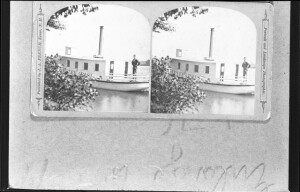 | 1883-1931 | Spofford Lake Chesterfield, N.H. "Enterprise" | A stereoscopic photograph of the Enterprise. A small screw steamer, Enterprise was launched on Spofford's Lake, West Chesterfield, NH, on July 1, 1876. (Vermont Phoenix, Brattleboro, VT, July 6, 1876). | MS0091/03.01-19#117 | |||||
| 11 | No image URL. | The use of chemicals in war. | LB53043 | |||||||
| 12 | No image URL. | Indian round table conference. | LB69341 | |||||||
| 13 | No image URL. | United States occupation of the Dominican Republic. | LB50232 | |||||||
| 14 | 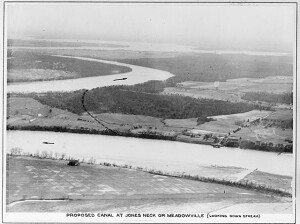 | 1932 | Chesterfield County (Va.).; Albemarle and Chesapeake Canal (Va. and N.C.)–Pictorial works. | Canals. | Aerial view of landscape with ribbons of water. A curved, dotted line is marked on the image indicating where the proposed canal would be constructed. See also MS0251/01-#207. | MS0251/01-#208 | ||||
| 15 | No image URL. | Pilot chart of the upper air. | LB42428 | |||||||
| 16 | 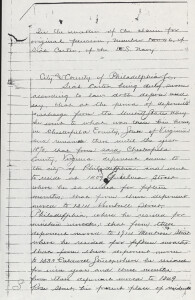 | Before 1992 | Chesterfield (Va.).; Philadelphia (Pa.). | Military pensions–Civil War, 1861-1865. United States | Photocopy of a one-page deposition of Siah Carter pursuant to his claim for a veteran's pension, concerning his residences after his discharge from the United States Navy. The original document is undated. Title devised by Library staff. | MS0164.001/01-001.09#19 | ||||
| 17 | 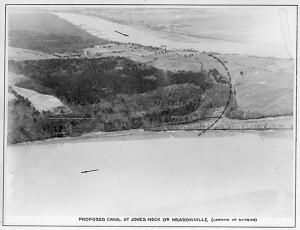 | 1932 | Chesterfield County (Va.).; Albemarle and Chesapeake Canal (Va. and N.C.)–Pictorial works. | Canals. | Aerial view of landscape with water in the foreground. A curved, dotted line is marked on the image indicating where the proposed canal would be constructed. See also MS0251/01-#208. | MS0251/01-#207 | ||||
| 18 | No image URL. | Confederate States of America. Army. Virginia Infantry Regiment, 1st | Virginia–Militia | Regiment was composed of volunteer militia companies from Richmond, Henrico and Chesterfield. | LB103685 | |||||
| 19 | No image URL. | Richmond and Danville Railroad Company | Quarries and quarrying–Virginia. | Includes a map of the granite quarries of Richmond and Chesterfield County. | LB104458 | |||||
| 20 | 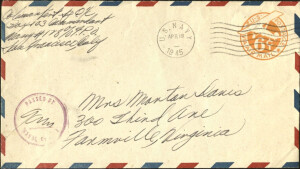 | 4/17/1945 | United States. Naval Reserve. Women's Reserve. | Two-page letter from Kent to his friend Marguerite. He wrote that he got pictures from home from his mother, and he is going to send her some of himself for Mother's day. He also mentioned plans to go on a sailing trip with WAVES as dates. He inquires about a girl again, and writes that he listens to the Chesterfield Supper Club on the radio. Includes air mail envelope with censor stamp. | MS0043/-01.02#03 | |||||
| 21 | 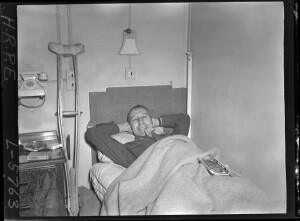 | 12/24/1943 | United States. Army–Officers.; United States. Army–Books and reading.; Andes (Steamship : 1939). | Col. William L. Ritter, O7437, returning from overseas duty on the "Andes." He had a broken leg. | World War, 1939-1945–Casualties–United States.; Crutches–Virginia–Newport News.; Cigarettes–Virginia–Newport News. | Shows a man reclining in a bed, he is smiling with his hands behind his head. Possibly he is in sick bay aboard a ship. He has a paperback book in his lap, it is "Above Suspicion" by Helen McInnes which was a best seller in 1941 and a movie staring Joan Crawford and Fred MacMurray in 1943. On his night stand is a pack of Chesterfield cigarettes and a package of Edgeworth tobacco. | P0003/01-#L-5763 | |||
| 22 | 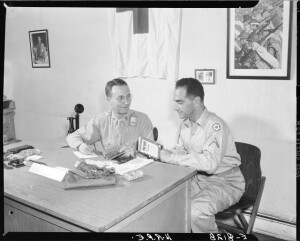 | 5/26/1944 | American Red Cross. | E8128 - Mr. Rockwell, Red Cross field director, HRPE, shows Red Cross overseas kit to soldier. 6-6-44 Official Photograph, U. S. Army Signal Corps, HRPE, Newport News, Va. | Soldiers–Recreation–Virginia–Newport News. | Two men in uniform sit behind a desk. One man, with a PFC's stripes, looks at a book called "The Rasp". Laid out on the table are a marbled plastic soap box, a stack of writing paper and envelopes, a pack of Chesterfield cigarettes, and a folding kit with safety pins and needles. | P0003/01-#E-8128 | |||
| 23 | 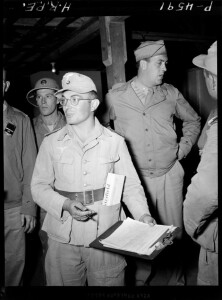 | 10/4/1943 | Port of Embarkation, Hampton Roads, Va. (U.S.). Disinfestation Plant. | "P4591 - Lt. Gunter Engel, Dentist, in disinfestation plant. 10-4-43 Official photograph U.S.Army Signal Corps, HRPE, Newport News, Va."; stamped in black "Secret" | Prisoners of war–Germany.; Prisoners of war–United States.; Paper–Virginia–Newport News.; Cigarettes–Packaging–Virginia–Newport News. | Close-up of German prisoner of war Lt. Gunter Engel. He is holding clipboard with papers and has a carton of Chesterfield cigarettes in his pocked. | P0003/01-#P-4591 | |||
| 24 | No image URL. | Virginia Canals and Navigations Society–Periodicals. | Boats and boating–Periodicals.; Navigation–Virginia–Periodicals.; Inland navigation–Virginia–Periodicals.; Waterways–Virginia–Periodicals.; Canals–Societies, etc. Virginia–Periodicals. | Description based on: vol. 1, no. 4 (Nov. 1995); caption title. | LB40472 | |||||
| 25 | No image URL. | Before 1992 | Shirley Plantation (Va.).; Chesterfield (Va.).; Philadelphia (Pa.). | African American sailors–United States.; Military pensions–Civil War, 1861-1865. United States; Survivors' benefits–United States.; Slavery–History–19th century. Virginia | Photocopy of a three page deposition in which Eliza Hulett discusses her claim for pension from her late husband Siah Carter. She also answers questions given to her by the interviewer for the deposition regarding her husband, his death, the confusion over his age at the time of death, and the confusion over his alias. The original document was dated April 25, 1894. | MS0164.001/01-001.09#20 | ||||
| 26 | No image URL. | Appomattox River (Va.)–Maps; Appomattox River (Va.)–Navigation. | Historic sites–Virginia–Chesterfield County–Maps. | Cover title. "A Virginia Canals & Navigations Society river atlas project" P. [1]. | LB40809 | |||||
| 27 | 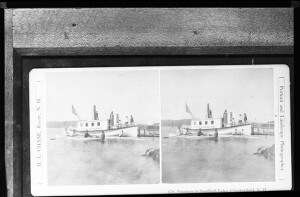 | 1883-1931 | Lake Chesterfield, N.H., "Enterprise" | Steamboats–New Hampshire. | This is a photograph of a stereoscopic view depicting the starboard side of a small steamboat. No record is found of a vessel Enterprise with a home port in New Hampshire. This vessel's name has not been verified. | MS0091/03.02-01#1056 | ||||
| 28 | No image URL. | United States. Naval Reserve. Women's Reserve. | Hawaii–Description and travel. | World War, 1939-1945–Personal narratives, American.; Sailors–Recreation–Hawaii. | The collection contains letters written by Yeoman 2nd Class Coleman W. Kent to Marguerite H. Davis from Hawaii between February 1944 and October 1945. Although he addresses Marguerite as “Sis” in numerous letters, it does not appear that they were related. The majority of the letters do not speak of his military service, but rather about travel and sightseeing in the Hawaiian Islands in the abundant free time that he had. Stationed on Oahu, presumably at Pearl Harbor, he had frequent opportunity to travel to Honolulu. He writes of U.S.O. dances, the arrival of W.A.V.E.S., and describes the end of war celebrations in Pearl Harbor and Honolulu. He also writes of finding part time work in his off hours, comments on the weather, and inquires about people at home. He often asks about his mother and Marguerite's daughter, Audrey Lee. Also included in the collection are two photographs of Kent in uniform. | MS0043 | ||||
| 29 | 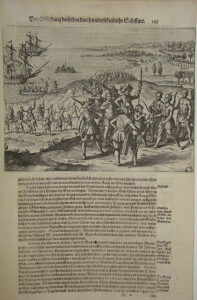 | SHORT DESCRIPTION: Page 543 from Johann Gottfriedt's 1655 publication 'Newe Welt Und Americanische Historien.' The image depicts the captive Pocahontas surrounded by English guards, while the young English interpreter Thomas Savage tries to persuade her two brothers to cease hostilities during the first Anglo-Powhatan war in March 1614. NOTES: From: Newe Welt Und Americanische Historien : Inhaltende Warhafftige und vollkommene Beschreibungen Aller West-Indianischen Landschafften/ Insulen/ Königreichen und Provintzien/ Seecusten/ fliessenden [...] / ... zusam[m]en getragen/ ... Durch Johann Ludwig Gottfriedt. Mit zugehörigen Landtafeln ... und ... Kupfferstücken ... gezieret und verlegt/ Durch Mattheum Merian/ ... Franckfurt : Meriansche Erben, 1655 In the section: West-Indianischer Historien Ander Theil/ Von Erfindung derselben durch underschiedliche Schiffarthen. In the "chapter": Summarische Relation der fürnehmbsten Reysen unnd Schiffarten in das Land Virginiam, biß auff unsere Zeit. Image on page 543. NOTES: Translation of the text that supports this image (page 543): But they only requested this to draw the matter to a halt, and so that they would have more time to settle their case. Although we noticed their cunning and deceit, we nevertheless granted their request and assured them until noon the following day that no harm would be done to them in the slightest, nor would any of their own be delayed, and that before we struck, our trumpeters and drummers would immediately give a signal with a bang. At our request, two of Powhatan's sons, their sister, who was not far in the country, came to us to see and confer with her. When they saw her and realized how she was being held so well by us, which they had previously believed to be the opposite, they were extremely pleased and promised that they would overcome their opponent without any doubt and that they would be able to ensure that their sister could be reconciled and a firm, unbreakable peace could be established with us. Therefore, these two brothers went with us to Port, after we had previously dispatched two English men, M. Johann Rolfe and M. Sparckes, to do this and all other things of the kind. NOTES: J. Frederick Fausz in the article 'An "Abundance of Blood Shed on Both Sides": England's First Indian War, 1609-1614' describes this scene on page 47: In March 1614 the English sailed up the York River to deliver an ultimatum to Wahunsonacock. As a precaution, they brought with them the captive Pocahontas. Here Pocahontas, surrounded by guards, and English interprester Thomas Savage try to persuade two of Pocahontas's brothers to cease hostilities. The Encyclopedia Virginia states this about the image: English interpreter Thomas Savage, gesturing at center, negotiates with two of Pocahontas's brothers (at right) in this engraving from Theodor de Bry's Americae (1634). Pocahontas, a daughter of the paramount chief Powhatan, was captured by the English in 1613, and is shown here surrounded by English guards as the interpreter converses with the Indigenous people. In A True Relation of such occurrences and accidents of noate (1608), John Smith recounted how an English delegation presented Powhatan with "a Boy of thirteen yeares old, called Thomas Salvage," who was described to the Indigenous chief as being the son of Captain Christopher Newport. Savage learned the Native language while staying with Powhatan, and his skills were critical in negotiating an end to the First Anglo-Powhatan War. Commentary by Barry Lawrence Ruderman Antique Maps: Pocahontas's capture occurred in the context of the First Anglo-Powhatan War, a conflict between the Jamestown settlers and the Native Americans that began late in the summer of 1609. In the first years of war, the English took control of the James River, both at its mouth and at the falls. Captain Samuel Argall, in the meantime, pursued contacts with Native American groups in the northern portion of Powhatan's paramount chiefdom. The Patawomecks who lived on the Potomac River were not always loyal to Powhatan and living with them was a young English interpreter named Henry Spelman. In March 1613, Argall learned that Pocahontas was visiting the Patawomeck village of Passapatanzy. With Spelman's help translating, Argall pressured the villagers to assist in Pocahontas's capture by promising an alliance with the English against the Powhatans. They tricked Pocahontas into boarding Argall's ship and held her for ransom, demanding the release of English prisoners held by her father along with various stolen weapons and tools. Powhatan returned the prisoners but failed to satisfy the colonists with the number of weapons and tools he returned. A long standoff ensued, during which the English kept Pocahontas captive. During the year-long wait she was held at Henricus, in modern-day Chesterfield County, Virginia. Little is known about her life there, although colonist Ralph Hamor wrote that she received "extraordinary courteous usage". In March 1614, the standoff built up to a violent confrontation between hundreds of English and Powhatan men on the Pamunkey River. At Powhatan's capital of Matchcot, the English encountered a group of some senior Native American leaders (but not Powhatan himself, who was away). The English permitted Pocahontas to talk to her countrymen. Pocahontas reportedly rebuked her father for valuing her "less than old swords, pieces, or axes", and told the Powhatan she preferred to live with the English. NOTES: This engraving comes from Johann Ludwig Gottfried's abridgment of Theodor de Bry titled Newe Welt und Americanische Historien [published in 1655]. Little is known about the German publisher Johann Ludwig Gottfried (c. 1584-1633), who inherited the Theodor De Bry’s (1528-1598) publishing firm. Gottfried studied theology in Heidelberg. As of 1603 he was active as deacon, afterwards as reformed priest in villages in the Electoral Palatinate's left side of the Rhine. Between 1625 and 1633 he was active in Offenbach. Owed to his talent for languages and his education in general, he became a highly esteemed assistant of Frankfurt publishers like Johann Theodor de Bry, de Bry's nephew Lucas Jennis and de Bry's son in law Matthäus Merian the Elder as of 1619. He made translations, epigrams, paraphrases and compilations for many distinguished publications. Between 1590 and 1634, de Bry and his sons issued thirteen volumes containing illustrated accounts of the expeditions of Magellan, Columbus, Vespucci, Cortes, Balboa, Raleigh, Drake, Smith, and many others. In most cases, theirs were the first images ever made of the Americas by Europeans. In 1631 Gottfried, who had worked on the volumes and inherited the de Bry family publishing firm, issued together with Matthaeus Merian (publisher, artist & engraver) a one-volume condensation "Newe Welt Vnd Americanische Historien/ Jnhaltende Warhafftige vnd volkommene Beschreibungen Aller West-Jndianischen Landschafften..." that used many of the original copper plates and supplemented them with new ones of more recent voyages." The first edition of the abridgment was published by Matthaeus Merian in 1631. It was reprinted in 1655. | CL16752 | |||||||
| 30 | 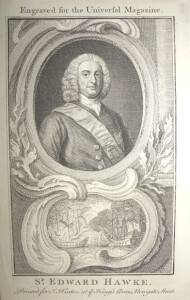 | NOTES: (R. Wyatt, 5/3/2001) From: Universal Magazine, The Universal Magazine of Knowledge and Pleasure was a monthly publication, June 1747 to December 1803. It contained news, letters, debates, poetry, music, biography, history, geography and other arts and sciences. Making use of plates, maps, and diagrams, it was prepared for the instruction and entertainment of the gentry, merchants, farmers, and tradesmen. (TMM Library AP3 U 58 C) SEE: LE 761, LE 767, LE 775, LE 849, LE 867, LE 1010, LE 1051 NOTES: Sir Edward Hawke (1705-1781) British admiral. He entered the navy in 1720 and first saw fighting as commander of a ship in the battle of Toulon (1744). He was promoted (1747) to rear admiral and in the same year inflicted a major defeat on a French squadron off La Rochelle. In the Seven Years War, Hawke relieved (1756) Admiral John Byng as commander in the Mediterranean and was appointed an admiral. In Nov., 1759, after blockading the French ports in the Bay of Biscay for six months, he won a decisive victory over the French fleet in Quiberon Bay. His victory averted the danger of a French invasion of Great Britain. He served (1766-71) as first lord of the admiralty and was raised (1776) to the peerage. During his long career Hawke did much to improve conditions in the fleet. [See biography by R. F. Mackay (1965).] NOTES: The Universal magazine. v.27. June 1760, Image found on page: 82: The above plate is a decorative portrait of Sir Edward Hawke. There is a small image represented below him of two ships in battle, the left of which is on fire. This small image likely represents the battle detailed in the text between British and French ships on October 14, 1747. The account below details his decorated naval career. [pg 82] As we have always been attentive, in our Magazine, to record whatever was memorable and praise-worthy in the Lives of illustrious Men, more especially of our own Countrymen, whose signal Services hace rendered dear to us, we therefore cannot omit making honourable Mention of Sir EDWARD HAWKE, by here presenting out readers with his Head finely engraved, and the following Summary of his principal Transactions. In the year 1734, Mr. Hawke, having been bred to the sea from a very early age, was made Captain of his Majesty’s sloop the Wolfe, and from this time took rank in the navy. In the engagement in the Mediterranean in 1743-4, he commanded the Berwick, broke the line in Admiral Rowley’s division, and took the Podor, (the only ship taken) was broke for his bravery, and restored by the King. In 1747, at a general promotion of Flag officers, he was made Rear admiral of the Blue. The same year the Lords of the Admiralty having received information that a very large fleet of merchant-ships, bound from the ports of France to the West-Indies, were collecting together at the isle of Aix, and that a strong squadron of ships of war had sailed from Brest to escort them, they made the necessary preparations to intercept them; and ordered out a fleet from Plymouth on this destination, under the command of Rear-admiral Hawke. This fleet set sail from Plymouth on the 9th of August, and continued cruising off the coast of Brittany, in expectation of intercepting the French. On the 14th of October, at seven in the morning, the Edinburgh made a signal for seeing seven sail in the south-east quarter, upon which Rear-admiral Hawke immediately made the signal for all the fleet to chase; about eight he saw a great number of ships, so crouded that he could not count them; but at ten he made a signal for forming a line of battle a-head. The French Commodore, when he first saw the British squadron in the horizon, crouding after him, he took them for some of his own fleet; but, when he discovered what they were, he threw out the signal for the merchant-men to make the best of their way, and at the same time made a signal for the men of war to form the line of battle; the Intrepide, Trident, an Terrible composed the van, the Tonant and Monarque the center, and the Severn, Fogueux and Neptune the rear. It was of the last importance that this line should form immediately; but, the preservation of the merchant-ships being the principal object, it was necessary to leave intervals, so that before they could all pass through a considerable time was elapsed, during which admiral Hawke made his dispositions; and, discovering that the escape of the convoy was their chief intention, made the signal for chasing before the line was formed; and in half an hour, observing that the head-most ships were within a proper distance, he made the signal to engage, which was immediately obeyed. The Lion and Princess Louisa began the engagement about a quarter before twelve, passing through a terrible fire, from the rear to the van of the French, and were followed by the rest of the ships as they came up; the Lion, Louisa, Tilbury, Eagle, Windsor, and Yarmouth behaved with the greatest intrepidity, though the French received them with the utmost bravery. Rear-admiral Hawke received several fires at a distance, before he could get near enough to engage the Severn, which he soon silenced, and left to be taken up by the frigates a-stern. Then, perceiving the Eagle and Edinburgh to be somewhat disabled by [pg 83] the Tonant, he kept as near the wind as possible, in order to assist them; but the attempt was frustrated by the Eagle’s falling twice on board the Devonshire, having had her wheel shot to pieces, all the men at it killed, and all her braces and bowlings gone, which forced the Rear-admiral to leeward, and prevented his attacking either the Monarque or the Tonant, within any distance to do execution. He however attempted both, especially the latter; but while he was engaged with her the breechings of all the lower deck guns of the Devonshire broke, and the guns flew fore and aft, which obliged her to shoot a-head, because her upper and quarter deck guns could not reach the Tonant. Capt. Harland, in the Tilbury, observing that the Tonant fired single guns at the Devonshire, with a view to dismast her, tacked and stood in between her and the Devonshire, and gave her a very smart fire. By this time the new breechings were all seized on board the Devonshire, and she was got almost along-side of the Trident of 64 guns, which the Rear-admiral immediately engaged, and soon silenced by a very brisk fire; but, observing the Kent, which appeared to have received little or no damage, at some distance astern of the Tonant, he flung out the signal for Capt. Fox to make sail a-head and engage her. The Admiral also, seeing some of his squadron at that time not so closely engaged as he could wish, made the signal for coming to a close engagement; and soon after the Devonshire got within musket shot of the Terrible. In the mean time, Capt. Saunders lay two hours closely engaged with the Neptune, which has 100 men killed, and 140 wounded, and had lost almost all her masts, before she struck, which she did about four o’clock. The mOnarque, Fougeus, and Severn surrendered, about the same time; the Trident struck about five to Admiral Hawke, as did also the Terrible about seven. The Tonant and Intrepide escaped, during the night, to a small French port, where they repaired their damages, and returned to Brest, having lost 200 men. As soon as the Terrible, Monarque, Neptune, Trident, Fougeux, and Severn had struck, and it beginning to grow very dark, Admiral Hawke thought proper to bring to for that night; and, as it was not possible to dispatch any ships after the convoy, he manned and victualled the Weazle sloop and sent her express to Commodore Legge, who commanded the squadron stationed about the Leeward islands, with an account of what had happened, bu which means tens of the merchant-men were taken. The Rear-admiral arrived, with his six prizes, at Spithead on the 31st of October. In this action Capt. Moore, now COmmodore Moore, lately stationed in the West-Indies, commanded the Devonshire, the Admiral’s own ship; and his behaviour was so gallant, that the Admiral sent him to England with news of his victory, and a particular recommendation. At the same time, he preferred a complaint against Capt. Fox for misbehaviour, by which two of the enemy’s principal ships escaped. Capt. Fox was afterwards tried and suspended. In November the same year he was made Knight of the Bath, as a reward for the signal service he had done his country in this action; and in the December following he was chosen Member of Parliament for Portsmouth. In the year 1748 he was sent on a cruise in the Bay, where he fell in with the Magnanime, one of the finest ships in the French navy, which was taken by the Nottingham, and has since been employed against the enemy with great advantage. The Admiral was also this year chosen an Ender Brother of the Trinity-house, an honour seldom conferred but as the reward of merit. He was soon after appointed to command a squadron which sailed on the 16th of January, and returned the 25th of July following. In the year 1749 he commanded the squadron that was appointed to convoy the transports that carried the colony of new settlers to Nova Scotia. He was also this year solemnly installed in his knighthood of the Bath. On the 6th of July he sat as President of a Court-martial that was held on board the Invincible, at Portsmouth, for the trial of Samuel Couchman, the First Lieutenant, and John Morgan, Lieutenant of the mariners, and several other Officers and seamen, for a conspiracy to seize his Majesty’s ship the Chesterfield, and carry her off from the coast of Africa, with a piratical intent. At this Court-martial, Couchman and morgan were sentenced to be shot; and the carpenter, carpenter’s mate, the quarter-master, and one seaman to be hanged: On all whom the sentence was afterwards executed. He was also the same year appointed President of a court-martial on board the Monarch man of war at Portsmouth, for the trial of an Officer of rank for disobeying of orders, of which he was convicted, and suspended for a year. In the month of December 1749 he sat in a Court-martial [pg. 84] held on board the Charlotte yacht at Deptford, for inquiring into the conduct of Rear-admiral Knowles, in an action between a fleet under his command and a Spanish Squadron, off Hispanola; when it appearing, that the Admiral attacked six ships with four, when he might have attacked six, and that when, after an hour’s fight within pistol-shot, his ship was disabled, he staid on board till she was refitted, and then carried her down again to the charge, instead of going aboard another ship immediately, he was reprimanded. He also sat at a Court-martial held at Deptford in February 1750, for the trial of Capt. Holmes and Capt. Powlet, who were accused by admiral Knowles for misbehaviour in the same action, when they were both, particularly Capt. Holmes, acquitted with great honour. On the 15th of August 1750 he was visited, on board the Monarch man of war, then riding at Spithead, by their Royal Highnesses the Prince and Princess of Wales, with several of their children, an honor which no admiral had ever received before. On the 3d of December the same year he was appointed President of the Court-martial for the trial of Admiral Griffin, for misconduct off Pondicherry; who, being found guilty of negligence, he was suspended from his rank as a Flag-officer during his majesty’s pleasure, but was afterwards restored. On June 16, 1756, on advice of Admiral Byng’s misbehaviour, he sailed from Portsmouth, with orders to supersede and send him home under arrest; and commanded the remainder of that year in the Mediterranean, during which time his Lady died. On the 24th of July 1757 he was appointed to command the squadron that was lent, in conjunction with some forces under the command of Sir John Mordaunt, against Rochfort, on the coast of France. This expedition not being successful, the Admiral, though he did all that could be done on his part, experienced the caprice of popular favour; for, at his return, instead of being received as usual, with ringing of bells and acclamations, he was insulted by a dumb peal. On the 22d of October 1757 he sailed again for the coast of France, and was afterwards joined by Admiral Boscawen; but, being detained by contrary winds, he did not arrive a second time in the road of Basque will the 3d of April, 1758, when he fell in with a large convoy of French ships, laden with provisions for North America, which he ran on shore, and so many of them were disabled that the rest could not proceed on their voyage, so that the service intended was wholly frustrated. On the 18th of May 1759 he sailed with a very strong fleet from Portsmouth, to observe the French squadron at Brest. He afterwards received the Prince on board, and kept his station till the 12th of October following, when he was driven from it by the violence of the wind, and in the beginning of November put into Plymouth; but on the 14th of the same month he sailed again, and on the 20th defeated the French fleet commanded by Mons. Conflans, for a particular account of which the reader is referred to VOL XXV, page 314, &c. For his service he received the thanks of the House of Commons, and his Majesty settled upon him and his sons, abd the survivor of them, 2000 l. per an | CL15773 | |||||||
| 31 | 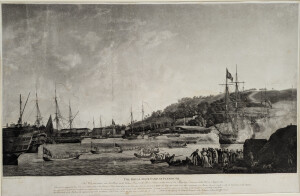 | SHORT DESCRIPTION: Black and white aquatint titled 'The Royal Dock Yard at Plymouth.' Drawn and engraved by Robert Dodd and published by John and Josiah Boydell. A view of the royal dockyard at Plymouth taken near Torr Point, on the Western Bank of the River Tamer during a visit by King George III. The print commemorates the royal visit and celebrates the growth of the dockyard as a testament to the increasing grandeur of the Royal Navy. The text below the image claims the dockyard's productivity to be superior to all other dockyards in the Kingdom and the world. A crowd gathers in the dock in the right foreground to witness the King. Men in rowboats fly royal ensigns and ships perform salutes in honor of the King. NOTES: From the webste morethannelson.com, The King's Naval Review at Plymouth, August 1789, by Richard Hiscocks, August 22, 2018: During the latter part of 1788 the health of King George III had been deteriorating as he continued to suffer from a disturbing condition that could not be diagnosed at the time, but which symptoms included a tendency to irrational behaviour and speech, repetitive verbosity, breathing difficulties, acute stomach pains, insomnia, and a foaming of the mouth. Rumours were soon afoot that he had completely lost his senses, and whilst his physicians stumbled from one hopeless remedy to another the government trembled at the thought that they might be required to ask his dissolute and radical son, Prince George, to assume the Regency. Then as the new year of 1789 dawned the King began to show signs of improvement, and within a couple of months he was deemed to have made a full recovery. To celebrate the poplar monarch s return to good health it was decided that he and his beloved wife, Queen Charlotte, should take a holiday at Weymouth with their daughters, and that a frigate, the Southampton 32, Captain Andrew Snape Douglas, together with a sail of the line, the Magnificent 74, Captain Richard Onslow, should be put at his disposal. Whilst in the West Country a visit by Their Majesties to Plymouth was arranged where a review of the naval facilities would be undertaken, and where a mock naval battle would also be staged for their delectation. Accordingly the royal family and their attendants left Weymouth to travel overland to Saltram House near Plymouth where they arrived on the afternoon of 15 August. The review of the dockyard facilities began at 11 a.m. on 17 August when the royal party consisting of the King, Queen Charlotte, and three of their daughters arrived at Plymouth to be saluted by the garrison, the rampart cannons, and the fort. They were then received by a host of notables including the dockyard commissioner Captain John Laforey, the King s great friend the Earl of Chesterfield, the first lord of the Admiralty Earl Chatham, the previous first lord of the Admiralty Earl Howe, and other members of the Board of Admiralty including Vice-Admiral Lord Hood. After taking refreshment the royal party went on board the the brand new Impregnable 98, Captain Thomas Byard, which was flying the flag of the commander-in-chief at Plymouth, Rear-Admiral Sir Richard Bickerton, an officer who on a previous fleet review in 1778 had been knighted for the honour of steering the King s barge. As the King stepped aboard the Impregnable the other ships in the port and in Plymouth Sound opened up with their own salute, and this was answered by the cannon on the Citadel and by a number of smaller installations, as well as a visiting Dutch man-of-war, the Lynx. After remaining aboard the Impregnable for upwards of an hour Their Majesties took their leave and returned to the shore in the royal barge, their progress being somewhat incongruously attended by a cutter crewed by seven young women resplendent in white gowns and black bonnets. Further time was spent in the dockyard before the royals left for Saltram House accompanied by a flotilla of boats, and being saluted all the way to their destination. Sadly the day was marred when a sloop carrying a number of spectators overturned and four women and a child were reportedly drowned, although when the King was made aware of the incident he quickly declared that any children orphaned by the disaster would be provided for. At 9 am the next day, 18 August, in fine clear weather and to a cacophony of salutes from the military installations ashore and ships in the harbour, the King, Queen and princesses were rowed out in Commissioner Laforey s barge to the Southampton, which was moored in Plymouth Sound having recently arrived from Weymouth with Lord Chatham and his party. The royal barge was preceded by Rear-Admiral Bickerton in one barge and Lord Chatham and Vice-Admiral Lord Hood in another, and its progress was acclaimed by a host of spectators gathered on the shore. An hour and a half after receiving the royal party the Southampton put to sea on a south south-easterly wind to be followed by the Magnificent and the frigate Lowestoffe 32, Captain Edmund Dod, the three men-of-war being accompanied by a hundred other vessels including the Duke of Richmond s yacht with a band in full swing. Shortly afterwards a sail of the line appeared from behind the Staddon Heights on the eastern side of the Sound, standing in on the larboard tack with the benefit of a gentle easterly breeze, and as the Southampton weathered the Mewstone a further six sail of the line, two frigates and two cutters came into view. This force was Commodore Samuel Granston Goodall s Squadron of Observation which, to some French concern, had recently been parading in the mouth of the Channel. When the Southampton came within half a mile of Goodall s ships a royal salute of twenty-one guns was fired by every vessel, whereupon the larger men-of-war, which were in line ahead and about two cable lengths apart, tacked out to sea and split into two divisions so as to begin the evolutions that would enable them to bring about a realistically mock action. Leading the line of four ships that constituted the supposed enemy force, and would be ironically cast as the French by the eager spectators, was the Cumberland 74, Captain John MacBride, and she was followed by the Bellona 74, the frigate Hebe 38 and Bedford 74. These vessels, which were otherwise identified by their white colours, assumed a line to leeward on the larboard tack and backed their topsails to allow Commodore Goodall s pennant ship Carnatic 74 at the head of His Majesty s force to bear down and attack them. She in turn was followed by the Orion 74, Director 64, and Goliath 74. The Carnatic took up a position abreast and at musket shot of the rear ship in the French line, this being the Bedford, the signal for battle was made, and as a furious gunfire began the other ships of Goodall s division came down with the wind to take their positions abreast of each enemy vessel. With the Magnificent and Lowestoft also joining the fun a staged battle began whilst the Southampton lay close by to windward in the east, flying the Royal Standard at the main mast, the Admiralty flag at the foremast, and the Union flag at the mizzen. As the action progressed MacBride s French squadron appeared to have the worst of it, and after some thirty minutes the remainder of his ships wore and tacked to larboard as if to effect repairs whilst his own command, the Cumberland, covered them by engaging three of the enemy. The action then resumed on the starboard tack and continued for a good hour and a half, with several of the vessels feigning damage aloft by letting go their topsail sheets as if to signify that their rigging had been shot away. This more belligerent phase of the action continued until about 3 p.m. when MacBride was obliged to strike his colours. At the conclusion of the engagement the Southampton made sail and took up a position to leeward of the lines of battle, and in succession Goodall s ships passed under her stern with their yards fully manned, firing another 21-gun salute and letting fly their topsails as they did so. The King, who had been in conversation with Lord Chatham and Lord Hood throughout the mock action, expressed concern for the safety of the men of the Orion at her mastheads, and appeared somewhat relieved when they descended without injury. He was also intrigued when the Cumberland passed by, for her starboard ports were manned by a number of Negroes dressed in white and sporting turbans. The captains then took to their barges to kiss hands with the King, following which the Southampton stood back into the Sound under the escort of the fleet in line ahead until at 4 p.m. Goodall made the signal for his ships to put about and head back out to sea. By 7 o clock in the evening the royal party was back at Saltram House, having spent eight hours on the water. Next day the inquisitive King rose early to return to the dockyard, his first stop being the Victualling Office where he demanded to taste a ships biscuit, and where he ordered a cask of beef to be opened so that a piece could be sent to Saltram for his dinner. Visits to the Lower Fort, the Citadel, ramparts, storehouses and underground works followed with the military officers in attendance, and he then went to the gun wharf to inspect the ordnance. Thereafter several days of non-official business were enjoyed before on the morning of the 22nd Their Majesties left Saltram House to return overland to Weymouth, whilst Lord Chatham and a number of other notables rejoined the Southampton and set sail for the same port. NOTES: From the Bury and Norwich Post, August 26, 1789, page 1: Saturday's Post. LONDON. NAVAL REVIEW at PLYMOUTH. About nine o’clock on Tuesday morning their Majesties, the Princesses, and suite, arrived at the Dock-yard from Saltram; from whence they rowed in barges to the Sound, where they embarked on board the Southampton, attended by the Magnificent of 74 guns, and immediately proceeded to sea, with the wind S. S. E. to meet the fleet of Commodore Goodall, of eight sail of the line, then standing into the Sound, in a line of battle a-head on the larboard tack. On the approach of the Royal Standard, the fleet saluted with 21 guns each; and tacked, and stood to sea, under an easy sail, followed by the Royal Frigate.—Soon after which the signal was made for a division, meant to represent the enemy fleet (consisting of the Cumberland, Bellona, Hebe, and Bedford) to bear and form to leeward, which they accordingly did, led by Capt. M’Bride. the Cumberland, under White Colours. The Commodore then made the signal for his own division (led by the Carnatic) to bear down and attack the enemy, opposing himself to the sternmost ship (the Bedford) in the enemy’s line. Soon after which he hoisted the signal for battle, and opened his cannonade; while the rest of his squadron approached their respective opponents to windward. The cannonade now appeared general in both lines. Several manoeuvres then took place, till a signal to desist firing, and bring the Commodore to bear N.E. terminated the action. During these different evolutions, the Royal Family, in the Southampton, were lying to, to windward, close by the scene of action. The day was very fine, with a steady breeze, and clear atmosphere, and the ocean covered with vessels of different kinds. The Royal Frigate now made sail, and bore up to leeward of the Line, and brought to; when the ships in succession (led by the Commodore) passed under her stern, and manned ship, cheered, and saluted with 21 guns each. The Royal Frigate, after receiving the personal compliments of the Commodore, and all the Captains in their barges, filled and stood into the Sound, escorted by the whole fleet in a line a-head. At four o’clock the fleet took leave of the Royal Standard, by general salute, tacked, and stood to sea. NOTES: The yard was known as HM Dockyard, Plymouth until 1843, when it was renamed HM Dockyard, Devonport. NOTES: This is from a set of six images by Robert Dodd showing Royal Dockyards. Published by John and Josiah Boydell, comprising 'A View of the Royal Dockyard at Blackwall' [LP 771] and 'A View of the Royal Dockyard at Deptford' [LP 768] issued on March 25, 1789; 'A View of the Royal Dockyard at Woolwich' [LP 770] and 'A View of the Royal Dockyard at Chatham' [LP 266] issued on October 29, 1789; 'A View of the Royal Dockyard at Plymouth' [LP 775] issued on September 1, 1790; and 'A View of the Royal Dockyard at Portsmouth' [LP 769] on November 1, 1790. According to National Maritime Museum, although Blackwall was a civilian yard, it built many navy ships and Dodd's view of it shows the launch of the 74-gun 'Bombay Castle', a warship built for the Navy as a gift from the East India Company. Presumably it was included to make the project a set of six rather than five. | CL18696 | |||||||
| 32 | 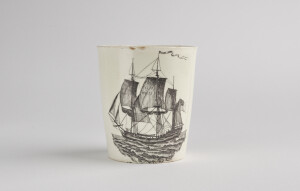 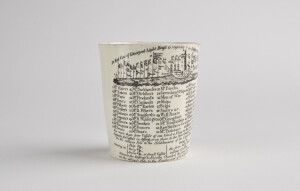 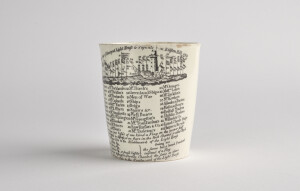 | SHORT DESCRIPTION: Creamware beaker without handle. The beaker is 3-7/16” height and 3-1/8” diameter at the top and 2-⅜” diameter at the base. The beaker is in good condition with some random staining and minor chips near the rim. The beaker is decorated with black transfer-printed images. On one side is a black transfer-printed image showing a port broadside view of a full-rigged British merchant ship under sail. The sails set include a flying jib and jib on the bowsprit. On the foremast a fore topsail (the foresail is furled). There is a fore topgallant sail mast and yard, but no sail appears. Between the foremast and mainmast a quadrilateral main topmast staysail is set. On the mainmast the mainsail is furled, the main topsail is set. The mast and yard of the main topgallant sail are visible but there is no sail. On the mizzenmast the mizzen topsail and mizzen sail are set. A long pennant with a cross of St. George at the hoist and forked fly end is flying from the mainmast. Interestingly the pennant is flying towards the stern rather than the bow. A British flag flies at the stern, again, it is pictured flying in the wrong direction. The sea underneath the ship is wrapped in a rococo design. On the opposite side is a black transfer-printed view of the signal tower and flagpoles at Bidston Hill (the windmill is not included), including flags numbered from 1 to 44 sitting to the north and south of the lighthouse. The transfer-print is titled “An East View of Liverpool Light House & Signals on Bidston Hill 1788.” Beneath the image is a numbered list of the shipowners keyed to the flags and a set of instructions for reading the signals. Reading from left to right, the names, in four columns, are: 1. Mr. Slater's; 2. Mr. Baker's; 3. Mr. Watt's; 4. Mr. Kent's; 5. Mr. Fisher's; 6. Mr. Galley’s; 7. Mr. Bolton's; 8. Mr. Ingram's; 9. Mr. Ashton's; 10. Mr. Kenyon's; 11. Mr. Bent's; 12. Mr. Backhouse's; 13. Mr. Dickson's; 14. Mr. Freeland's; 15. Mr. Copland's; 16. Messrs. Earle's; 17. Mr. R. Fisher's; 18. Mr. Staniforth's; 19. Mr. R. Wilding's; 20. Mr. Brooks's; 21. Mr. France's; 22. Mr. Boats's; 23. Mr. Birch's; 24. Greenland Ships; 25. Men of War; 26. Ships; 27. Brigs; 28. Snows &c; 29. Well Boats; 30. Mr. Gregson's; 31. Mr. Tomlinson's; 32. Rawlinson & Co.; 33. Mr. Tarleton's; 34. Mr. Orange’s; 35. Messrs. Lakes's; 36. Mr. Jackson's; 37. Mr. Kewley's; 38. Allanson & Barton; 39. Mason & Bourn; 40. Belfast Traders; 41. Dublin Traders; 42. Willock & Co.; 43. London Cheese Ships; and 44. Harper & Brade. Underneath the columns are the instructions for reading the signals: For more than four Vessels of one kind a Flag on the proper staff., Signals for Vessels in distress, or on shore in the Rock Channel or about Hoyle, On the Oblique Pole to the Southward of the Light House, Coming in, Ship [symbol of a ball with a flag half Mast], Brig [a symbol of a cone, broad end up, and flag at half mast], Snow or small Vessels [symbol of a cone with point up and a flag at half mast], Going out, The same [as ship] but a broad Pendant instead of a Flag, signals for Distress in Formby Channel the same as above on the Oblique Pole to the Northward of the Light House. The beaker is unmarked leaving the manufacturer(s) identified. In Transactions of the Historic Society of Lancashire and Cheshire, session 1880-1881, volume XXXIII, Charles T. Gattey discusses local manufacturers in the article “The Liverpool Potteries.” Gatty indicates the firm of John Sadler and Guy Green on Harrington Street were early producers of printing on pottery. Unfortunately, Sadler retired in 1770 which predates the estimated date of this beaker (1788). Gatty does indicate that “much of the ware upon which their [Sadler and Green] prints appear were made by Josiah Wedgwood. According to printedbritishpotteryandporcelain.com, “From about 1761 Wedgwood was sending creamware to Liverpool to be printed at the Sadler workshop. This grew into a large business and continued into the period when [Guy] Green was running the printing business alone.” As there weren’t too many firms actively printing on pottery in Liverpool at the time, it’s possible this jug was one of those printed and decorated by Green (who didn’t retire until 1799) for the Liverpool market. If, as printedbritishpotteryandporcelain.com states, the business between Wedgwood and Green was large, it’s possible that Green bought creamware from Wedgwood for the printing of the Bidston Hill images. Of course, this is merely conjecture at this point. NOTES: According to bidstonhill.org.uk in 1763 a signal station was built on Bidston Hill and functioned as a complicated early warning system using flags and flagpoles. Bidston Hill can be seen for many miles in all directions and the windmill there served as a navigational daymark long before the erection of the signal station. In 1778 there were 14 flagpoles and by 1820 there were 195 poles. Each flagpole was 30 ft (9.14 m) tall and made of Baltic Pine. As merchant ships rounded the Point of Ayr or sailed past Formby Point the ship would be spotted and identified. Flag runners were employed to watch for ships and had 11 minutes to raise the correct company’s flag on the right pole, followed by the correct cargo flag. This enabled supervisors in the docks to ready their workforce to unload the ship (and it meant the workers would be paid only for the time they spent working). The flag signaling station operated until about 1840. A lighthouse was built at the station in 1771 by Liverpool's dockmaster William Hutchinson as a navigational aid. The lighthouse was designed to work in conjunction with the Leasowe Lighthouse to form a pair of leading lights that helped ships avoid sandbanks in the channel to Liverpool. In his 1795 history of Liverpool, James Wallace wrote: “There are at this time fifty-eight [signals], of which forty-nine belong to particular merchants, the remainder are to distinguish and shew if the vessels coming in are Greenlanders, men of war, or if the vessel is ship, brig, or snow; there are also immediate signals to the town of all vessels seen in distress in either of the channels, that thereby speedy assistance may be given.” NOTES: According to printedbritishpotteryandporcelain.com, the earliest version of the Bidston Hill image is dated 1788 and has 43 numbered flags. A second version with 47 numbered flags was also produced in 1789. On the 1789 image, Mr. Galley's name appears but Mr. Orange's does not indicated the image was produced sometime between January (Orange's death) and April 1789 (Galley's death). In 1793 a third version with 56 numbered flags was produced and after France declared war on Britain a fourth version with a new flag indicating “Enemies” was added. With the date 1788 and a list of 44 names, this beaker seems to be one of the earliest examples of the Bidston Hill decorated creamware. NOTES: The flags in the image represent a mix of Liverpool merchants, many of which are engaged in the slave trade. Research has been unable to provide the exact identities of some of the men/companies. 1) Gill Slater was a Liverpool merchant who made 48 slave trading voyages between 1759 and 1793. Slater was part owner of the ships: Richmond, Hannah, Prince Tom, Betty, York, Lancashire Witch, Ingram, Kitty, Will, Sportsman, President, Defiance, Tartar, Wasp, Edward, Saint Leger, King George, Anna, Chesterfield, Comet, Mary (wholly owned), Seaflower, Commerce, Isabella and Tammerlane. He appears to have conducted other business as he was part owner of a fishing smack named Liver. Slater also conducted privateering voyages during the American Revolution. In 1777 Slater was part of a committee formed to draw up a plan for the better regulation of the slave trade. 2) Peter Baker (1731-1796) was a Liverpool merchant and slave trader in partnership with his son-in-law, John Dawson. According to the Slaving Voyages database, between 1768 and 1789 Baker was part owner of ships on 54 slaving voyages. He and Dawson started slaving voyages together in 1781 (both were active before that point, just not together). According to Stephen Behrendt in “The Captains in the British Slave Trade from 1785 to 1807” between 1783 and 1792 Baker and Dawson was the largest company of slave traders in England and had a contract with the Spanish government to supply enslaved peoples to the Spanish colonies between 1785 and 1788. Behrendt states that even after the Spanish market opened to all merchants in 1788, Baker and Dawson remained the leading British slave trader to the Spanish Caribbean. Captain William Sherwood was given command of Baker & Dawson's Princess Royal (596) from 1786 to 1788, Brothers (325) in 1789, Garland (525) in 1790 and 1791, and Elliot (271) in 1792. Between 1785 and 1795 Joseph Fayrer sailed four voyages for Baker & Dawson, William Forbes and Joseph Withers each sailed five, and Thomas Molyneux commanded six. Ships partially or wholly owned by Baker and Dawson included: Mosley Hill, Princess Royal, Hero, Champion, Telemachus, Prince, Elliott, Garland Sisters, Young Hero, Brothers, Blaydes, Carnatic, and Mentor. According to William Gomer in History of the Liverpool Privateers and Letters of Marque: With an Account of the Liverpool Slave Trade Baker and Dawson had a shipbuilding firm on the Estuary Bank. 3) Richard Watt (1724-1796), a Liverpool merchant. According to History of the Liverpool Privateers and Letters of Marque: Richard Watt came to Liverpool from Standish, near Wigan, around 1740 and was hired by Mr. Geoffry Walley to look after his horse and chaise. Watt was sent to evening school and Walley advanced him to the counting house and employed Watt as a supercargo to Jamaica. Watt settled in Jamaica and made a large fortune. Watt returned to Liverpool in August 1782 as head of the firm Messrs. Watt and Walker. Watt died in 1796 leaving a fortune of around half-a-million pounds to his two nephews, Richard Watt and Richard Walker. 4) Richard Kent, Liverpool merchant. The Voice of Liverpool Business: The first chamber of commerce and the Atlantic economy, 1774-c.1796, by R. J. Bennett, R. J., lists Ken as a timber and general merchant and ship-owner with a salt manufactory at Northwich and a white lead manufactory. His primarily market was America. 5) John Fisher (1740-1791), Liverpool merchant and periodic slave trader. R. J. Bennett describes him as a major ship-owner, ship builder and merchant, conducting some slaving. Fisher owned ships (Betsey, Assistance, Philip Stevens and Robust) that conducted six slaving voyages between 1787 and 1792. 6) John Galley, (died April 1789) Liverpool merchant and slave trader, shareholder in ships conducting 29 slave trading voyages between 1770 and 1789. Owned at least one privateering vessel during the American Revolution (Emperor). 7) John Bolton (1756-1837), major Liverpool merchant, slave trader and slave owner (with Staniforth, Brooks Slater and Ryan). Between 1788 and 1807 Bolton was part owner of ships that conducted 68 slaving voyages (President, Comet, Abigail, Bolton, Gudgeon, Surprise, Maria, Betsey, Cart, King George, John, Christopher, and Elizabeth). 8) Francis Ingram (1793-1815), Liverpool merchant, slave trader and privateer. Merchant in tar and pitch, ship owner (with Earle, Leyland and Staniforth), slaver, and banker. Owner of the privateer Enterprize/Enterprise in 1779/1780. Company Messrs. Francis Ingram & Co. Started slaving in 1761, between 1785 and 1804 partly owners ships conducted 57 slaving voyages (Kitty, Darnall, Hornet, Ingram, Brooks, Mary, Dick, Elliot, Blaydes, Aeolus, Albion, Clemison, Ann, Onslow, George, King George, Liverpool Hero, and Huges). 9) Nicholas Ashton (1742-1833), Liverpool merchant exporting salt and coat to America. Ship owner. Saltworks at St. Helens and Dungeon. Coal mining and salt at St. Helens with George Case. Co-owned the privateer Marchioness of Granby (260 tons, 20 guns) with the Marquis of Granby. Messrs. Ashton & Co owned a small privateer Lady Granby (45 tons, 10 guns) and Jenny (80 tons, 12 guns). 10) James Kenyon, Liverpool merchant and cotton importer. Fourth largest cotton importer in Liverpool. A. Krichtal, in an unpublished masters thesis titled Liverpool and the Raw Cotton Trade: A Study of the Port and its Merchant Community, 1770-1815 identifies James Kenyon as the 4th largest Liverpool cotton importer from the West Indies, 1786-1815, sourcing 5,277,880 lbs in this time period, and cites his main cotton supply area as Barbados. He was particularly active in the 1790s when he was the 3rd highest Liverpool cotton importer from all locations, sourcing 4,403,000 lbs. Krichtal also indicates he was one of several major Liverpool cotton importers who, while not heavily invested in slave trading, did become strongly involved in the shipping of plantation supplies to the Caribbean. 11) Robert Bent (1744/1745-1831/1832) Liverpool merchant and slave trader. MP for Aylesbury. Slave trader with Ellis Bent. He was a major slave-trader with 38 voyages recorded in the 1790s and early 1800s, most from Liverpool but with three from London. Slaving Voyages database lists 37 voyages between 1783 and 1804 (ships: Stanley, Lady Penrhyn, Renown, Ellis, Clemson, Abigail, Susannah, Little Ben, Ariel, Chambres, Ocean, Britannia, William, King William, and Hector). 12) Mr. Backhouse: there were four merchants named Backhouse in Liverpool Registry of Merchant Ships (Daniel, John, Stephen, and Thomas). A likely candidate is Daniel Backhouse (1741-1811) who was a Liverpool merchant and major ship-owner (with Tarleton and others) who also engaged in slaving. He was a Chamber of Commerce member. Daniel was also part owner of the privateer ship named Jenny (140 tons) as well as a privateer brig named Jenny. 13) William Dickson Sr. (1740-1802), Liverpool merchant and slave trader. Part or whole owner ships conducting 32 slaving voyages between 1783 and 1800 (ships: Benson, Henrietta, Mary, James, Joshua, Commerce, Tamerland, Sarah, and Vanguard). He was joined by his sons in shipowner/slaving in 1796. 14) Peter Freeland (1748-1795?), Liverpool Merchant and one time slave trader (ship named Edward in 1784 ). In 1779 Peter was a 1/16th owner of the privateer Enterprize/Enterprise. He also owned a privateer named Basil. 15) John Copland (born 1727?), Liverpool merchant and slave trader. Copland was the part owner of ships that conducted 41 slaving voyages between 1780 and 1794 (ships Kitty, Oronoko, Perseverance, Preston, Betty, Thomas, John, Peggy, Christopher, and Nancy). 16) Probably Thomas (1754-1822) and William Earle (1759-1839) (firm of T & W Earle & Co.), sons of William Earle (1721-1788), a major Liverpool merchant who operated a packet service to Leghorn (Livorno). He was a major ship owner with Hodgson, Ingram and Leyland. William (Sr.) began making slaving voyages in 1754. A Ralph Earle joined William in partial ownership of some vessels starting in 1763 (brother born 1715). Thomas's first slaving voyage is 1768 and all three men had part ownership of Dispatch, Mentor, and Ann. William Jr.'s first slaving voyage was Preston in 1780 with Thomas Jr. and William. The Earle’s were full or part owners of ships conducting 168 voyages between 1754 and 1805. According to Nichoas Radburn in “William Davenport, the Slave Trade, and Merchant Enterprise in Eighteenth Century Liverpool” William Earle was the sixth most active slave trader in the 1740-1790 period in Liverpool. 17) Ralph Fisher (1746-1803), Liverpool merchant and prolific slave trader. Part owner of ships that conducted 93 slaving voyages between 1782 and 1801. 18) Thomas Staniforth (1735-1803), Liverpool merchant, slave trader and politician. Chamber of Commerce deputy chair in 1777 and 1781, Lord Mayor of Liverpool 1797-1798. Part owner of ships that conducted 79 slaving voyages between 1758 and 1806. See: Chapter 3, Portrait of a Slave-Trading Family: The Staniforths of Liverpool, by Jane Longmore in Britain’s History and Memory of Transatlantic Slavery. 19) Richard Wilding (died 1797), Bidston Hill lighthouse keeper and slave trader. According to Dr. Stephen Pickles, Richard Wilding was the keeper of Bidston lighthouse until his death in 1797. He states: We know that Richard Wilding had one of the flags on Bidston Hill (indeed it is referred to in a Letter of Marque in Gomer William's book "History of the Liverpool Privateers and Letters of Marque with an Account of the Liverpool Slave Trade 1774-1812.") Part owner of ships that conducted 26 slaving voyages between 1777 and 1791. 20) Joseph Brooks Jr. (1746–1823), Liverpool merchant, major shipowner, and slave trader (with Ingram, Stanifordh, Carruthers, Slater and Ryan). May have also been owner of a privateer in 1779. Bailiff of Liverpool in 1784 and 1802. Co-owner of the slave ship Brooks/Brookes which was the subject of a broadside by abolitionist William Elford in 1788. 21) James France (1728-1795), Liverpool merchant. Owner of several privateers (James, Tyger). In partnership with Thomas Hayhurst in France & Co./France & Nephew. The company also owned several privateers (Ellen, Mary Fearon). Imported sugar rum and other commodities from the West Indies. In 1793 James France initiated the construction of a gigantic 14-story warehouse situated in the Goree area of Liverpool (between Water, Brunswick and Drury streets). It became known as one of the Goree Warehouses. This area was later named Back Goree. The warehouse is recognizable in late 18th century images by its immense size and a large weathervane in the shape of a ship that capped the building (burned down in 1802). 22) William Boats (1716-1794) According to “History of the Liverpool Privateers and Letters of Marque: With an Account of the Liverpool Slave Trade” William Boats/Boates (nicknamed “Billy Boats/Boates”) had been found in a boat as a child and was brought up by the person that found him who gave him the surname Boats. He was placed in the Blue Coat School and then served an apprenticeship at sea. He rose to be the commander of a slave ship and eventually became one of the leading merchants and shipowners of Liverpool. In 1779/1780 Messrs. Boats and [John] Gregson owned two privateers (Ellis (340 tons, 24 guns) and Gregson (250 tons, 24 guns). Boats was responsible for 157 slave voyages. 23) Joseph Birch (1755-1833) Liverpool merchant, slave ship owner and politician; MP for Nottingham. Birch was associated with nine voyages from Liverpool and owned stock in the East India Company. Member of the West India Planters and Merchants committee. 24) Greenland ships are ships involved in whaling. 25) Men of War are the signal for Royal Navy warships. 26) Ships is a generic category for all other ships. 27) Brigs are fast, maneuverable two-masted ships. 28) Snows are similar to brigs, but with the addition of a secondary mast immediately behind the main mast. 29) Well boats are cod smacks or boats with wells to keep fish alive until delivery. 30) William Gregson Sr. (1721-1800), Liverpool merchant and prolific slave trader. Between 1745 and 1801 Gregson and his sons (John and James) conducted 213 slave voyages between 1745 and 1801. Gregson served as Lord Mayor of Liverpool in 1762. In his later career he branched out into banking and insurance. According to Carolyn Dalton in “Memorial to Zong: The Gregson Syndicate” Gregson's vessels carried 58,201 Africans of whom 9,148 died on board. The Gregson’s, along with Edward Wilson and James Aspinall were the owners of the slave ship Zong. On a voyage in 1781 the ship missed its destination in the Caribbean thanks to a navigational error and spent an extra three weeks at sea. Drinking water grew short and some of the enslaved Africans and crew became sick. The crew threw approximately 131 Africans overboard so the merchants could claim insurance money for the “lost cargo.” The case came to symbolize the horrors of the Middle Passage and strengthened the abolition movement. 31) John Tomlinson, Liverpool merchant trading in Lisbon/Oporto. A man named John Tomlinson made 51 slaving voyages between 1759 and 1787. No slaving voyages attributed to John Tomlinson were made after 1787 and only one ship name in the LRoMS appears on a slaving voyage with Tomlinson's name. The following advertisements were found: Leeds Intelligencer for a voyage of the Grape to Lisbon in September 1786; in Gore's Liverpool General Advertiser, May 28, 1795, a voyage for the ship Sisters to Lisbon and ship Brothers to Oporto); the same source dated August 20, 1795 documents a voyage of the ship Rochdale to Lisbon. It seems odd that such a prolific slave trader suddenly stopped and became a merchant to Lisbon/Oporto. I think there might be a mistake here or maybe the business moved from father to son and the son was not a slave trader? Since there were no slaving voyages after 1787 and the first ceramics with Bidston Hill image didn't come out until 1788, I'm limiting John Tomlinson to merchant. 32) Rawlinson & Co. There were a number of Rawlinson’s involved in business in Liverpool. Henry Rawlinson (1743-1786), agent for the Chamber of Commerce of Liverpool 1782 and MP for Liverpool (1780-1784), and a merchant who owned property in the West Indies. Henry was a partner in Rawlinsons & Chorley with John Chorley but I found no evidence this company existed after 1776). Henry is documented as holding shares in the slave ship Molly along with Abraham Rawlinson Jr. in 1776. Henry died two years before the first pitcher with the Bidston Hill image was produced so it seems unlikely this is the right man. Abraham Rawlinson (1738-1803) was an English politician and merchant, but he traded out of the port of Lancaster. I also found an A. and J. Rawlinson in business together in 1781, possibly in Liverpool. 33) Mr. Tarleton. There were a number of men named Tarleton active in Liverpool at the time this pitcher was produced. Thomas Tarleton (1753–1820) [Centre for the Study of the Legacies of British Slavery: Liverpool slave-trader and slave-owner on Grenada. Other brothers were: John Tarleton, Banastre Tarleton and Clayton Tarleton. Thomas Tarleton & Co. were also shown as the owners of La Resource in Demerara in 1798. Thomas Tarleton had been paid £68,000 on his withdrawal from the slave-trading and West India mercantile partnership with John Tarleton and Daniel Backhouse [at a date not given].], John Tarleton (1755–1841), Clayton Tarleton, John Tarleton Jr., and Jane Tarleton, slave traders. 34) William Orange (1721-1789), a Liverpool merchant engaged in the Dublin-Liverpool packet service. The Slaving Voyages database lists William Orange as a shareholder in two ships that conducted four slaving voyages between 1772 and 1774. I found a report of a William Orange who died on January 23, 1789 and was buried at St. James in the District of Toxteth, Liverpool. In his 1991 master’s theses dissertation “Economic Development and Political Authority: Norfolk, Virginia merchant-magistrates, 1736-1800” by Thomas Costa documents the history of a man named William Orange that seems to fit our merchant. According to Costa a man named William Orange joined the Royal Navy in 1740. His duties brought him to Virginia where he married in 1743 and settled in Norfolk. Commercial success elevated Orange to the position of borough common councilman by 1750. By the American Revolution, Orange’s holdings had grown to 21 dwellings, 11 warehouses, 3 sheds and a “very large and valuable wharf.” In 1766 Orange was associated with the Sons of Liberty. In 1767 he resigned his council seat and in 1768 Orange became an “inoculationist” (i.e. a supporter of inoculating people against smallpox). His involvement in the smallpox inoculation dispute led him to leave the colony and return to England probably before June 1771 [when he disappeared from the list of tithable persons in Norfolk]. In January and February 1776, fires set by British troops caused the nearly complete destruction of Norfolk. Orange lost forty buildings and property amounting to £4,792. Orange had moved to Liverpool, Lancaster, England and was a merchant at 27 Duke Street, Liverpool. His will was dated June 1789 (probate; died January 23, 1789). 35) Messrs. Lake were William Charles Lake (1753-1836), Thomas Lake, Richard Lake (of Jamaica), Liverpool merchant, Irish shipping packet service, and slave traders who were part owners of ships conducting 12 slaving voyages between 1773 and 1788. William Charles Lake was the son-in-law of William Orange. When Orange died in 1789, William Charles Lake & Company took over Orang'es Liverpool to Dublin packet service. 36) John Jackson, Liverpool merchant, part owner of slaving ships between 1770-1775. I’m not entirely sure this is the right gentleman. 37) Patrick, John and Philip Kewley, Liverpool merchants and slave traders. Between 1784 and 1787 John was part owner in ships conducting 13 slaving voyages. Between 1788 and 1800 the John and Patrick were part owners of ships conducting 40 slaving voyages. John was part owner of ships conducting 3 slaving voyages between 1801 and 1803. Philip’s name does not appear as the owner of ships conducting slaving voyages. Philip was probably a member of Liverpool’s Chamber of Commerce. 38) John Allanson, Thomas Barton (1753-1799), William Barton (1755-1826, lives in Barbados), Liverpool merchants and slave traders. Early 1792 Allanson sold all shares to Bartons; 6 slaving voyages between 1779 and 1784 (nearly all Allanson, 1 in 1784 includes Thomas), 1 voyage in 1784 by Thomas; 2 slaving voyages between 1801-1802 by William partnered with John Higginson. The Bartons specialized in the import of sugar, cotton, and spirits from the island of Barbados to Liverpool. Allanson and Barton obtained letters of marque for their ship captains so they could attack and capture French ships after 1793. 39) Edward Mason and Cornelius Bourne, Liverpool merchants and slave traders (before 1785). Mason & Bourne made 10 slaving voyages between 1768 and 1785; It seems they may have stopped being partners in 1791; found advertisement for the men in the Manchester Mercury June 9, 1789 (selling cyder and Perry), but nothing after that. 40) Belfast traders were cargo ships traveling between Liverpool and Belfast. 41) Dublin traders were ships trading with Ireland. 42) Found William Willock & Co in Chester Chronicle (Chester bumps up against Liverpool) October/November 1775; July/August 1776; March/November 1777; August 1778; August 1779; October 1781; August/October 1782; September 1784; January/May/July/October/December 1785; July 1787; January 1801; possibly active through 1810; Based on the advertisements I'm assuming the company represented on the jug is William Willock & Co. who were simply merchants and not slave traders during the 1788 to 1800 time period. 43) London Cheese Ships were ships coming to collect Cheshire cheese which was exported from Liverpool to London. 44) William Harper (1749–1815) and Robert Brade (1747–1815), slave traders. Owners or part owners of ships conducting 53 slaving voyages between 1784 and 1800. Brade's last slaving voyage was in 1799. William continues in the slave trading business without Brade as part owner in ships that conducted 23 slaving voyages between 1801-1807. NOTES: Notes made in the China File by Nola Hill - work done in the '40's or early 50's per Harold Sniffen, 12/7/81.. East View of Liverpool Lighthouse and Signals on Bidston Hill, 1788 - with 44 signals around it. Each signal is numbered and below is a key. c. 1800 Reverse - British Frigate Leeds ware Drinking mug 3-1/2 x 3 | CL5679 | |||||||
| 33 | No image URL. | SHORT DESCRIPTION: Creamware pitcher of baluster form (wide-bellied and tapering to the top rim and foot) with a loop handle. The pitcher is approximately 5-3/4” height and 5-3/4” width overall including the spout and handle. The diameter of the rim is 3-3/16” and the diameter of the base is 3-1/4”. The spout stands about 1” from the rim and the loop handle is 9/16” wide. The pitcher is broken in two large pieces and multiple fragments. There is staining around the rim. The spout is chipped and darkly stained. The foot of the base is also chipped. The pitcher is decorated with black transfer-printed images. On one side is a black transfer-printed image showing a port broadside view of a full-rigged British merchant ship under sail. The sails set include a flying jib and jib on the bowsprit. On the foremast a foresail, fore topsail and fore topgallant sail (which is set but the yard isn’t hoisted) are set. Between the foremast and mainmast a main topmast staysail is set. On the mainmast the mainsail is furled, the main topsail and main topgallant sail are set, but again the yard of the main topgallant sail has not been hoisted leaving the sail billowing. On the mizzenmast the mizzen topsail is set and the mizzen sail is furled. A long pennant with a forked fly end flies from the mainmast. A British flag flies at the stern. Framing the sea at the bottom of the image is a maritime vignette of an anchor, cannon, drum, flag, spears, buoy and other items. The quality of the transfer print on FN 225 is much better than that of FN 364. On the opposite side is a black transfer-printed view of the signal tower and flagpoles at Bidston Hill (the windmill is not included), including flags numbered from 1 to 44 sitting to the north and south of the lighthouse. The transfer-print is titled “An East View of Liverpool Light House & Signals on Bidston Hill 1788.” At the top of the lighthouse, to the left of flag 29, is the Liver Bird, the symbol of Liverpool. Beneath the image is a numbered list of the shipowners keyed to the flags and a set of instructions for reading the signals. Reading from left to right, the names, in four columns, are: 1. Mr. Slater's; 2. Mr. Baker's; 3. Mr. Watt's; 4. Mr. Kent's; 5. Mr. Fisher's; 6. Mr. Galley’s; 7. Mr. Bolton's; 8. Mr. Ingram's; 9. Mr. Ashton's; 10. Mr. Kenyon's; 11. Mr. Bent's; 12. Mr. Backhouse's; 13. Mr. Dickson's; 14. Mr. Freeland's; 15. Mr. Copland's; 16. Messrs. Earle's; 17. Mr. R. Fisher's; 18. Mr. Staniforth's; 19. Mr. R. Wilding's; 20. Mr. Brooks's; 21. Mr. France's; 22. Mr. Boats's; 23. Mr. Birch's; 24. Greenland Ships; 25. Men of War; 26. Ships; 27. Brigs; 28. Snows &c; 29. Well Boats; 30. Mr. Gregson's; 31. Mr. Tomlinson's; 32. Rawlinson & Co.; 33. Mr. Tarleton's; 34. Mr. Orange’s; 35. Messrs. Lakes's; 36. Mr. Jackson's; 37. Mr. Kewley's; 38. Allanson & Barton; 39. Mason & Bourn; 40. Belfast Traders; 41. Dublin Traders; 42. Willock & Co.; 43. London Cheese Ships; and 44. Harper & Brade. Underneath the columns are the instructions for reading the signals: For more than four Vessels of one kind a Flag on the proper staff., Signals for Vessels in distress, or on shore in the Rock Channel or about Hoyle, On the Oblique Pole to the Southward of the Light House, Coming in, Ship [symbol of a ball with a flag half Mast], Brig [a symbol of a cone, broad end up, and flag at half mast], Snow or small Vessels [symbol of a cone with point up and a flag at half mast], Going out, The same [as ship] but a broad Pendant instead of a Flag, signals for Distress in Formby Channel the same as above on the Oblique Pole to the Northward of the Light House. The jug is unmarked leaving the manufacturer(s) identified. In Transactions of the Historic Society of Lancashire and Cheshire, session 1880-1881, volume XXXIII, Charles T. Gattey discusses local manufacturers in the article “The Liverpool Potteries.” Gatty indicates the firm of John Sadler and Guy Green on Harrington Street were early producers of printing on pottery. Unfortunately, Sadler retired in 1770 which predates the estimated date of this beaker (1788). Gatty does indicate that “much of the ware upon which their [Sadler and Green] prints appear were made by Josiah Wedgwood. According to printedbritishpotteryandporcelain.com, “From about 1761 Wedgwood was sending creamware to Liverpool to be printed at the Sadler workshop. This grew into a large business and continued into the period when [Guy] Green was running the printing business alone.” As there weren’t too many firms actively printing on pottery in Liverpool at the time, it’s possible this jug was one of those printed and decorated by Green (who didn’t retire until 1799) for the Liverpool market. If, as printedbritishpotteryandporcelain.com states, the business between Wedgwood and Green was large, it’s possible that Green bought creamware from Wedgwood for the printing of the Bidston Hill images. Of course, this is merely conjecture at this point. NOTES: According to bidstonhill.org.uk in 1763 a signal station was built on Bidston Hill and functioned as a complicated early warning system using flags and flagpoles. Bidston Hill can be seen for many miles in all directions and the windmill there served as a navigational daymark long before the erection of the signal station. In 1778 there were 14 flagpoles and by 1820 there were 195 poles. Each flagpole was 30 ft (9.14 m) tall and made of Baltic Pine. As merchant ships rounded the Point of Ayr or sailed past Formby Point the ship would be spotted and identified. Flag runners were employed to watch for ships and had 11 minutes to raise the correct company’s flag on the right pole, followed by the correct cargo flag. This enabled supervisors in the docks to ready their workforce to unload the ship (and it meant the workers would be paid only for the time they spent working). The flag signaling station operated until about 1840. A lighthouse was built at the station in 1771 by Liverpool's dockmaster William Hutchinson as a navigational aid. The lighthouse was designed to work in conjunction with the Leasowe Lighthouse to form a pair of leading lights that helped ships avoid sandbanks in the channel to Liverpool. In his 1795 history of Liverpool, James Wallace wrote: “There are at this time fifty-eight [signals], of which forty-nine belong to particular merchants, the remainder are to distinguish and shew if the vessels coming in are Greenlanders, men of war, or if the vessel is ship, brig, or snow; there are also immediate signals to the town of all vessels seen in distress in either of the channels, that thereby speedy assistance may be given.” NOTES:According to printedbritishpotteryandporcelain.com, the earliest version of the Bidston Hill image is dated 1788 and has 43 numbered flags. A second version with 47 numbered flags was also produced in 1789. On the 1789 image, Mr. Galley's name appears but Mr. Orange's does not indicated the image was produced sometime between January (Orange's death) and April 1789 (Galley's death). In 1793 a third version with 56 numbered flags was produced and after France declared war on Britain a fourth version with a new flag indicating “Enemies” was added. With the date 1788 and a list of 44 names, this beaker seems to be one of the earliest examples of the Bidston Hill decorated creamware. NOTES: The flags in the image represent a mix of Liverpool merchants, many of which are engaged in the slave trade. Research has been unable to provide the exact identities of some of the men/companies. 1) Gill Slater was a Liverpool merchant who made 48 slave trading voyages between 1759 and 1793. Slater was part owner of the ships: Richmond, Hannah, Prince Tom, Betty, York, Lancashire Witch, Ingram, Kitty, Will, Sportsman, President, Defiance, Tartar, Wasp, Edward, Saint Leger, King George, Anna, Chesterfield, Comet, Mary (wholly owned), Seaflower, Commerce, Isabella and Tammerlane. He appears to have conducted other business as he was part owner of a fishing smack named Liver. Slater also conducted privateering voyages during the American Revolution. In 1777 Slater was part of a committee formed to draw up a plan for the better regulation of the slave trade. 2) Peter Baker (1731-1796) was a Liverpool merchant and slave trader in partnership with his son-in-law, John Dawson. According to the Slaving Voyages database, between 1768 and 1789 Baker was part owner of ships on 54 slaving voyages. He and Dawson started slaving voyages together in 1781 (both were active before that point, just not together). According to Stephen Behrendt in “The Captains in the British Slave Trade from 1785 to 1807” between 1783 and 1792 Baker and Dawson was the largest company of slave traders in England and had a contract with the Spanish government to supply enslaved peoples to the Spanish colonies between 1785 and 1788. Behrendt states that even after the Spanish market opened to all merchants in 1788, Baker and Dawson remained the leading British slave trader to the Spanish Caribbean. Captain William Sherwood was given command of Baker & Dawson's Princess Royal (596) from 1786 to 1788, Brothers (325) in 1789, Garland (525) in 1790 and 1791, and Elliot (271) in 1792. Between 1785 and 1795 Joseph Fayrer sailed four voyages for Baker & Dawson, William Forbes and Joseph Withers each sailed five, and Thomas Molyneux commanded six. Ships partially or wholly owned by Baker and Dawson included: Mosley Hill, Princess Royal, Hero, Champion, Telemachus, Prince, Elliott, Garland Sisters, Young Hero, Brothers, Blaydes, Carnatic, and Mentor. According to William Gomer in History of the Liverpool Privateers and Letters of Marque: With an Account of the Liverpool Slave Trade Baker and Dawson had a shipbuilding firm on the Estuary Bank. 3) Richard Watt (1724-1796), a Liverpool merchant. According to History of the Liverpool Privateers and Letters of Marque: Richard Watt came to Liverpool from Standish, near Wigan, around 1740 and was hired by Mr. Geoffry Walley to look after his horse and chaise. Watt was sent to evening school and Walley advanced him to the counting house and employed Watt as a supercargo to Jamaica. Watt settled in Jamaica and made a large fortune. Watt returned to Liverpool in August 1782 as head of the firm Messrs. Watt and Walker. Watt died in 1796 leaving a fortune of around half-a-million pounds to his two nephews, Richard Watt and Richard Walker. 4) Richard Kent, Liverpool merchant. The Voice of Liverpool Business: The first chamber of commerce and the Atlantic economy, 1774-c.1796, by R. J. Bennett, R. J., lists Ken as a timber and general merchant and ship-owner with a salt manufactory at Northwich and a white lead manufactory. His primarily market was America. 5) John Fisher (1740-1791), Liverpool merchant and periodic slave trader. R. J. Bennett describes him as a major ship-owner, ship builder and merchant, conducting some slaving. Fisher owned ships (Betsey, Assistance, Philip Stevens and Robust) that conducted six slaving voyages between 1787 and 1792. 6) John Galley, (died April 1789) Liverpool merchant and slave trader, shareholder in ships conducting 29 slave trading voyages between 1770 and 1789. Owned at least one privateering vessel during the American Revolution (Emperor). 7) John Bolton (1756-1837), major Liverpool merchant, slave trader and slave owner (with Staniforth, Brooks Slater and Ryan). Between 1788 and 1807 Bolton was part owner of ships that conducted 68 slaving voyages (President, Comet, Abigail, Bolton, Gudgeon, Surprise, Maria, Betsey, Cart, King George, John, Christopher, and Elizabeth). 8) Francis Ingram (1793-1815), Liverpool merchant, slave trader and privateer. Merchant in tar and pitch, ship owner (with Earle, Leyland and Staniforth), slaver, and banker. Owner of the privateer Enterprize/Enterprise in 1779/1780. Company Messrs. Francis Ingram & Co. Started slaving in 1761, between 1785 and 1804 partly owners ships conducted 57 slaving voyages (Kitty, Darnall, Hornet, Ingram, Brooks, Mary, Dick, Elliot, Blaydes, Aeolus, Albion, Clemison, Ann, Onslow, George, King George, Liverpool Hero, and Huges). 9) Nicholas Ashton (1742-1833), Liverpool merchant exporting salt and coat to America. Ship owner. Saltworks at St. Helens and Dungeon. Coal mining and salt at St. Helens with George Case. Co-owned the privateer Marchioness of Granby (260 tons, 20 guns) with the Marquis of Granby. Messrs. Ashton & Co owned a small privateer Lady Granby (45 tons, 10 guns) and Jenny (80 tons, 12 guns). 10) James Kenyon, Liverpool merchant and cotton importer. Fourth largest cotton importer in Liverpool. A. Krichtal, in an unpublished masters thesis titled Liverpool and the Raw Cotton Trade: A Study of the Port and its Merchant Community, 1770-1815 identifies James Kenyon as the 4th largest Liverpool cotton importer from the West Indies, 1786-1815, sourcing 5,277,880 lbs in this time period, and cites his main cotton supply area as Barbados. He was particularly active in the 1790s when he was the 3rd highest Liverpool cotton importer from all locations, sourcing 4,403,000 lbs. Krichtal also indicates he was one of several major Liverpool cotton importers who, while not heavily invested in slave trading, did become strongly involved in the shipping of plantation supplies to the Caribbean. 11) Robert Bent (1744/1745-1831/1832) Liverpool merchant and slave trader. MP for Aylesbury. Slave trader with Ellis Bent. He was a major slave-trader with 38 voyages recorded in the 1790s and early 1800s, most from Liverpool but with three from London. Slaving Voyages database lists 37 voyages between 1783 and 1804 (ships: Stanley, Lady Penrhyn, Renown, Ellis, Clemson, Abigail, Susannah, Little Ben, Ariel, Chambres, Ocean, Britannia, William, King William, and Hector). 12) Mr. Backhouse: there were four merchants named Backhouse in Liverpool Registry of Merchant Ships (Daniel, John, Stephen, and Thomas). A likely candidate is Daniel Backhouse (1741-1811) who was a Liverpool merchant and major ship-owner (with Tarleton and others) who also engaged in slaving. He was a Chamber of Commerce member. Daniel was also part owner of the privateer ship named Jenny (140 tons) as well as a privateer brig named Jenny. 13) William Dickson Sr. (1740-1802), Liverpool merchant and slave trader. Part or whole owner ships conducting 32 slaving voyages between 1783 and 1800 (ships: Benson, Henrietta, Mary, James, Joshua, Commerce, Tamerland, Sarah, and Vanguard). He was joined by his sons in shipowner/slaving in 1796. 14) Peter Freeland (1748-1795?), Liverpool Merchant and one time slave trader (ship named Edward in 1784 ). In 1779 Peter was a 1/16th owner of the privateer Enterprize/Enterprise. He also owned a privateer named Basil. 15) John Copland (born 1727?), Liverpool merchant and slave trader. Copland was the part owner of ships that conducted 41 slaving voyages between 1780 and 1794 (ships Kitty, Oronoko, Perseverance, Preston, Betty, Thomas, John, Peggy, Christopher, and Nancy). 16) Probably Thomas (1754-1822) and William Earle (1759-1839) (firm of T & W Earle & Co.), sons of William Earle (1721-1788), a major Liverpool merchant who operated a packet service to Leghorn (Livorno). He was a major ship owner with Hodgson, Ingram and Leyland. William (Sr.) began making slaving voyages in 1754. A Ralph Earle joined William in partial ownership of some vessels starting in 1763 (brother born 1715). Thomas's first slaving voyage is 1768 and all three men had part ownership of Dispatch, Mentor, and Ann. William Jr.'s first slaving voyage was Preston in 1780 with Thomas Jr. and William. The Earle’s were full or part owners of ships conducting 168 voyages between 1754 and 1805. According to Nichoas Radburn in “William Davenport, the Slave Trade, and Merchant Enterprise in Eighteenth Century Liverpool” William Earle was the sixth most active slave trader in the 1740-1790 period in Liverpool. 17) Ralph Fisher (1746-1803), Liverpool merchant and prolific slave trader. Part owner of ships that conducted 93 slaving voyages between 1782 and 1801. 18) Thomas Staniforth (1735-1803), Liverpool merchant, slave trader and politician. Chamber of Commerce deputy chair in 1777 and 1781, Lord Mayor of Liverpool 1797-1798. Part owner of ships that conducted 79 slaving voyages between 1758 and 1806. See: Chapter 3, Portrait of a Slave-Trading Family: The Staniforths of Liverpool, by Jane Longmore in Britain’s History and Memory of Transatlantic Slavery. 19) Richard Wilding (died 1797), Bidston Hill lighthouse keeper and slave trader. According to Dr. Stephen Pickles, Richard Wilding was the keeper of Bidston lighthouse until his death in 1797. He states: We know that Richard Wilding had one of the flags on Bidston Hill (indeed it is referred to in a Letter of Marque in Gomer William's book "History of the Liverpool Privateers and Letters of Marque with an Account of the Liverpool Slave Trade 1774-1812.") Part owner of ships that conducted 26 slaving voyages between 1777 and 1791. 20) Joseph Brooks Jr. (1746–1823), Liverpool merchant, major shipowner, and slave trader (with Ingram, Stanifordh, Carruthers, Slater and Ryan). May have also been owner of a privateer in 1779. Bailiff of Liverpool in 1784 and 1802. Co-owner of the slave ship Brooks/Brookes which was the subject of a broadside by abolitionist William Elford in 1788. 21) James France (1728-1795), Liverpool merchant. Owner of several privateers (James, Tyger). In partnership with Thomas Hayhurst in France & Co./France & Nephew. The company also owned several privateers (Ellen, Mary Fearon). Imported sugar rum and other commodities from the West Indies. In 1793 James France initiated the construction of a gigantic 14-story warehouse situated in the Goree area of Liverpool (between Water, Brunswick and Drury streets). It became known as one of the Goree Warehouses. This area was later named Back Goree. The warehouse is recognizable in late 18th century images by its immense size and a large weathervane in the shape of a ship that capped the building (burned down in 1802). 22) William Boats (1716-1794) According to “History of the Liverpool Privateers and Letters of Marque: With an Account of the Liverpool Slave Trade” William Boats/Boates (nicknamed “Billy Boats/Boates”) had been found in a boat as a child and was brought up by the person that found him who gave him the surname Boats. He was placed in the Blue Coat School and then served an apprenticeship at sea. He rose to be the commander of a slave ship and eventually became one of the leading merchants and shipowners of Liverpool. In 1779/1780 Messrs. Boats and [John] Gregson owned two privateers (Ellis (340 tons, 24 guns) and Gregson (250 tons, 24 guns). Boats was responsible for 157 slave voyages. 23) Joseph Birch (1755-1833) Liverpool merchant, slave ship owner and politician; MP for Nottingham. Birch was associated with nine voyages from Liverpool and owned stock in the East India Company. Member of the West India Planters and Merchants committee. 24) Greenland ships are ships involved in whaling. 25) Men of War are the signal for Royal Navy warships. 26) Ships is a generic category for all other ships. 27) Brigs are fast, maneuverable two-masted ships. 28) Snows are similar to brigs, but with the addition of a secondary mast immediately behind the main mast. 29) Well boats are cod smacks or boats with wells to keep fish alive until delivery. 30) William Gregson Sr. (1721-1800), Liverpool merchant and prolific slave trader. Between 1745 and 1801 Gregson and his sons (John and James) conducted 213 slave voyages between 1745 and 1801. Gregson served as Lord Mayor of Liverpool in 1762. In his later career he branched out into banking and insurance. According to Carolyn Dalton in “Memorial to Zong: The Gregson Syndicate” Gregson's vessels carried 58,201 Africans of whom 9,148 died on board. The Gregson’s, along with Edward Wilson and James Aspinall were the owners of the slave ship Zong. On a voyage in 1781 the ship missed its destination in the Caribbean thanks to a navigational error and spent an extra three weeks at sea. Drinking water grew short and some of the enslaved Africans and crew became sick. The crew threw approximately 131 Africans overboard so the merchants could claim insurance money for the “lost cargo.” The case came to symbolize the horrors of the Middle Passage and strengthened the abolition movement. 31) John Tomlinson, Liverpool merchant trading in Lisbon/Oporto. A man named John Tomlinson made 51 slaving voyages between 1759 and 1787. No slaving voyages attributed to John Tomlinson were made after 1787 and only one ship name in the LRoMS appears on a slaving voyage with Tomlinson's name. The following advertisements were found: Leeds Intelligencer for a voyage of the Grape to Lisbon in September 1786; in Gore's Liverpool General Advertiser, May 28, 1795, a voyage for the ship Sisters to Lisbon and ship Brothers to Oporto); the same source dated August 20, 1795 documents a voyage of the ship Rochdale to Lisbon. It seems odd that such a prolific slave trader suddenly stopped and became a merchant to Lisbon/Oporto. I think there might be a mistake here or maybe the business moved from father to son and the son was not a slave trader? Since there were no slaving voyages after 1787 and the first ceramics with Bidston Hill image didn't come out until 1788, I'm limiting John Tomlinson to merchant. 32) Rawlinson & Co. There were a number of Rawlinson’s involved in business in Liverpool. Henry Rawlinson (1743-1786), agent for the Chamber of Commerce of Liverpool 1782 and MP for Liverpool (1780-1784), and a merchant who owned property in the West Indies. Henry was a partner in Rawlinsons & Chorley with John Chorley but I found no evidence this company existed after 1776). Henry is documented as holding shares in the slave ship Molly along with Abraham Rawlinson Jr. in 1776. Henry died two years before the first pitcher with the Bidston Hill image was produced so it seems unlikely this is the right man. Abraham Rawlinson (1738-1803) was an English politician and merchant, but he traded out of the port of Lancaster. I also found an A. and J. Rawlinson in business together in 1781, possibly in Liverpool. 33) Mr. Tarleton. There were a number of men named Tarleton active in Liverpool at the time this pitcher was produced. Thomas Tarleton (1753–1820) [Centre for the Study of the Legacies of British Slavery: Liverpool slave-trader and slave-owner on Grenada. Other brothers were: John Tarleton, Banastre Tarleton and Clayton Tarleton. Thomas Tarleton & Co. were also shown as the owners of La Resource in Demerara in 1798. Thomas Tarleton had been paid £68,000 on his withdrawal from the slave-trading and West India mercantile partnership with John Tarleton and Daniel Backhouse [at a date not given].], John Tarleton (1755–1841), Clayton Tarleton, John Tarleton Jr., and Jane Tarleton, slave traders. 34) William Orange (1721-1789), a Liverpool merchant engaged in the Dublin-Liverpool packet service. The Slaving Voyages database lists William Orange as a shareholder in two ships that conducted four slaving voyages between 1772 and 1774. I found a report of a William Orange who died on January 23, 1789 and was buried at St. James in the District of Toxteth, Liverpool. In his 1991 master’s theses dissertation “Economic Development and Political Authority: Norfolk, Virginia merchant-magistrates, 1736-1800” by Thomas Costa documents the history of a man named William Orange that seems to fit our merchant. According to Costa a man named William Orange joined the Royal Navy in 1740. His duties brought him to Virginia where he married in 1743 and settled in Norfolk. Commercial success elevated Orange to the position of borough common councilman by 1750. By the American Revolution, Orange’s holdings had grown to 21 dwellings, 11 warehouses, 3 sheds and a “very large and valuable wharf.” In 1766 Orange was associated with the Sons of Liberty. In 1767 he resigned his council seat and in 1768 Orange became an “inoculationist” (i.e. a supporter of inoculating people against smallpox). His involvement in the smallpox inoculation dispute led him to leave the colony and return to England probably before June 1771 [when he disappeared from the list of tithable persons in Norfolk]. In January and February 1776, fires set by British troops caused the nearly complete destruction of Norfolk. Orange lost forty buildings and property amounting to £4,792. Orange had moved to Liverpool, Lancaster, England and was a merchant at 27 Duke Street, Liverpool. His will was dated June 1789 (probate; died January 23, 1789). 35) Messrs. Lake were William Charles Lake (1753-1836), Thomas Lake, Richard Lake (of Jamaica), Liverpool merchant, Irish shipping packet service, and slave traders who were part owners of ships conducting 12 slaving voyages between 1773 and 1788. William Charles Lake was the son-in-law of William Orange. When Orange died in 1789, William Charles Lake & Company took over Orang'es Liverpool to Dublin packet service. 36) John Jackson, Liverpool merchant, part owner of slaving ships between 1770-1775. I’m not entirely sure this is the right gentleman. 37) Patrick, John and Philip Kewley, Liverpool merchants and slave traders. Between 1784 and 1787 John was part owner in ships conducting 13 slaving voyages. Between 1788 and 1800 the John and Patrick were part owners of ships conducting 40 slaving voyages. John was part owner of ships conducting 3 slaving voyages between 1801 and 1803. Philip’s name does not appear as the owner of ships conducting slaving voyages. Philip was probably a member of Liverpool’s Chamber of Commerce. 38) John Allanson, Thomas Barton (1753-1799), William Barton (1755-1826, lives in Barbados), Liverpool merchants and slave traders. Early 1792 Allanson sold all shares to Bartons; 6 slaving voyages between 1779 and 1784 (nearly all Allanson, 1 in 1784 includes Thomas), 1 voyage in 1784 by Thomas; 2 slaving voyages between 1801-1802 by William partnered with John Higginson. The Bartons specialized in the import of sugar, cotton, and spirits from the island of Barbados to Liverpool. Allanson and Barton obtained letters of marque for their ship captains so they could attack and capture French ships after 1793. 39) Edward Mason and Cornelius Bourne, Liverpool merchants and slave traders (before 1785). Mason & Bourne made 10 slaving voyages between 1768 and 1785; It seems they may have stopped being partners in 1791; found advertisement for the men in the Manchester Mercury June 9, 1789 (selling cyder and Perry), but nothing after that. 40) Belfast traders were cargo ships traveling between Liverpool and Belfast. 41) Dublin traders were ships trading with Ireland. 42) Found William Willock & Co in Chester Chronicle (Chester bumps up against Liverpool) October/November 1775; July/August 1776; March/November 1777; August 1778; August 1779; October 1781; August/October 1782; September 1784; January/May/July/October/December 1785; July 1787; January 1801; possibly active through 1810; Based on the advertisements I'm assuming the company represented on the jug is William Willock & Co. who were simply merchants and not slave traders during the 1788 to 1800 time period. 43) London Cheese Ships were ships coming to collect Cheshire cheese which was exported from Liverpool to London. 44) William Harper (1749–1815) and Robert Brade (1747–1815), slave traders. Owners or part owners of ships conducting 53 slaving voyages between 1784 and 1800. Brade's last slaving voyage was in 1799. William continues in the slave trading business without Brade as part owner in ships that conducted 23 slaving voyages between 1801-1807. | CL5678 | |||||||
| 34 | 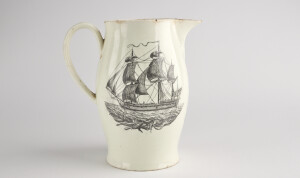 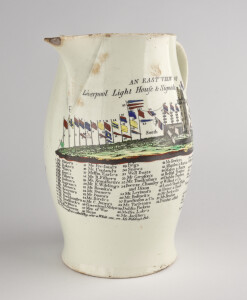 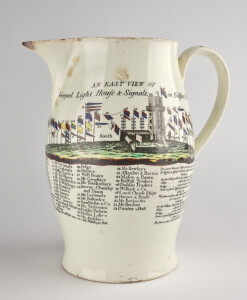 | SHORT DESCRIPTION: Creamware pitcher of baluster form (wide-bellied and tapering to the top rim and foot) with a loop handle. The pitcher is 7-1/16” height and 7” width overall including the spout and handle. The diameter of the rim is 3-⅝” and the diameter of the base, which is slightly splayed, is 3-¾”. The pitcher is approximately 5” width at the center of the bulbous section of the jug. The spout stands about 1-½” from the rim and the loop handle is 2” at its deepest point and 11/16” wide. The pitcher is in fair to good condition with some random staining near the rim. The spout is chipped and darkly stained at the tip. The pitcher is decorated with black transfer-printed images, one of which has been highlighted with colored enamel. On one side is a black transfer-printed image showing a port broadside view of a full-rigged British merchant ship under sail. The sails set include a flying jib and jib on the bowsprit. On the foremast a foresail, fore topsail and fore topgallant sail (which is set but the yard isn’t hoisted) are set. Between the foremast and mainmast a main topmast staysail is set. On the mainmast the mainsail is furled, the main topsail and main topgallant sail are set, but again the yard of the main topgallant sail has not been hoisted leaving the sail billowing. On the mizzenmast the mizzen topsail is set and the mizzen sail is furled. A long pennant with a forked fly end flies from the mainmast. A British flag flies at the stern. Framing the sea at the bottom of the image is a maritime vignette of an anchor, cannon, drum, flag, spears, buoy and other items. On the opposite side is a black transfer-printed view of the signal tower and flagpoles at Bidston Hill (the windmill is not included), including flags numbered from 1 to 52 sitting to the north and south of the lighthouse. The transfer-print is titled “An East View of Liverpool Light House & Signals on Bidston Hill.” The flags are painted in overglaze enamels in red, blue, yellow and white. The lighthouse is painted in shades of gray while the ground underneath is painted in green, yellow and brown/red. At the top of the lighthouse, to the left of flag 31, is the Liver Bird, the symbol of Liverpool. Beneath the image is a numbered list of the shipowners keyed to the flags and a set of instructions for reading the signals. At the base of the spout there is a fragment of a printed compass rose turned on its side to orient north to the right. Half of the rose and the directional arrow were not transferred to the pitcher leaving an odd curved “E”. Reading from left to right, the names, in four columns, are: 1. Mr. Slater's; 2. Mr. Baker's; 3. Mr. Watt's; 4. Mr. Kent's; 5. Mr. Fisher's; 6. Mr. Bolton's; 7. Mr. Ingram's; 8. Mr. Ashton's; 9. Mr. Kenyon's; 10. Mr. Bent's; 11. Mr. Backhouse's; 12. Mr. Bradstock's; 13. Mr. Dickson's; 14. Messrs. Brown's; 15. Mr. Freeland's; 16. Mr. Copland's; 17. Messrs. Earle's; 18. Mr. R. Fisher's; 19. Mr. Staniforth's; 20. Mr. R. Wilding's; 21. Mr. Brooks's; 22. Mr. France's; 23. Mr. Boats's; 24. Mr. Birch's; 25. Mr. C. Jones's; 26. Greenland Ships; 27. Men of War; 28. Ships; 29. Brigs; 30. Snows; 31. Well Boats; 32. Mr. Gregson's; 33. Mr. Tomlinson's; 34. Breeze, Chamley and Dixon; 35. Mr. Leyland's; 36. Mr. Bostock's; 37. Rawlinson & Co.; 38. Mr. Tarleton's; 39. Dublin Packets; 40. Messrs. Lakes's; 41. Mr. Jackson's; 42. Mr. Kewley's; 43. Allanson & Barton; 44. Mason & Bourn; 45. Belfast Traders; 46. Dublin Traders; 47. Willock & Co.; 48. London Cheese Ships; 49. Harper & Brade; 50. Mr. Beckwith's; 51. Mr. Benson's; 52. Dunbar & Hall and one unnumbered name: Mr. Thompson's a Red Flag over a White one, on Mr. Wilding's Pole. To the right of the columns are the instructions for reading the signals. In two sentences in two lines is the text: For more than four vessels of one kind a Flag on the proper staff. For Vessels in Distress or on shore in the Rock Channel or about Hoyle. Followed by the signals for vessels coming in: On the Oblique Pole to the Southward of the Light House; Ship....a Ball with a Flag half Mast.; Brigg.....a cone broad end & Flag half Mast.; Snow or small Vessel dº. small end up & a Flag dº; and the signals for vessels going out: The same as above but a broad Pendant instead of a Flag. The instructions also provide signals for vessels “In Formby Channel”: for vessels coming in: On the Oblique Pole to the Northward of the Light House; Ship.....a Ball with a Flag half Mast; Brigg.....a Cone Broad end up & Flag half Mast; Snow or small Vessel dº. small end up & a Flag dº. Signals for vessels going out: The same as above but a broad Pendant instead of a Flag. The jug is unmarked leaving the manufacturer(s) identified. In Transactions of the Historic Society of Lancashire and Cheshire, session 1880-1881, volume XXXIII, Charles T. Gattey discusses local manufacturers in the article “The Liverpool Potteries.” Gatty indicates the firm of John Sadler and Guy Green on Harrington Street were early producers of printing on pottery. Unfortunately, Sadler retired in 1770 which predates the estimated date of this jug (1790-1792). Gatty does indicate that “much of the ware upon which their [Sadler and Green] prints appear were made by Josiah Wedgwood. According to printedbritishpotteryandporcelain.com, “From about 1761 Wedgwood was sending creamware to Liverpool to be printed at the Sadler workshop. This grew into a large business and continued into the period when [Guy] Green was running the printing business alone.” As there weren’t too many firms actively printing on pottery in Liverpool at the time, it’s possible this jug was one of those printed and decorated by Green (who didn’t retire until 1799) for the Liverpool market. If, as printedbritishpotteryandporcelain.com states, the business between Wedgwood and Green was large, it’s possible that Green bought creamware from Wedgwood for the printing of the Bidston Hill images. Of course, this is merely conjecture at this point. NOTES: According to bidstonhill.org.uk in 1763 a signal station was built on Bidston Hill and functioned as a complicated early warning system using flags and flagpoles. Bidston Hill can be seen for many miles in all directions and the windmill there served as a navigational daymark long before the erection of the signal station. In 1778 there were 14 flagpoles and by 1820 there were 195 poles. Each flagpole was 30 ft (9.14 m) tall and made of Baltic Pine. As merchant ships rounded the Point of Ayr or sailed past Formby Point the ship would be spotted and identified. Flag runners were employed to watch for ships and had 11 minutes to raise the correct company’s flag on the right pole, followed by the correct cargo flag. This enabled supervisors in the docks to ready their workforce to unload the ship (and it meant the workers would be paid only for the time they spent working). The flag signaling station operated until about 1840. A lighthouse was built at the station in 1771 by Liverpool's dockmaster William Hutchinson as a navigational aid. The lighthouse was designed to work in conjunction with the Leasowe Lighthouse to form a pair of leading lights that helped ships avoid sandbanks in the channel to Liverpool. In his 1795 history of Liverpool, James Wallace wrote: “There are at this time fifty-eight [signals], of which forty-nine belong to particular merchants, the remainder are to distinguish and shew if the vessels coming in are Greenlanders, men of war, or if the vessel is ship, brig, or snow; there are also immediate signals to the town of all vessels seen in distress in either of the channels, that thereby speedy assistance may be given.” NOTES: According to printedbritishpotteryandporcelain.com, the earliest version of the Bidston Hill image is dated 1788 and has 43 numbered flags. A second version with 47 numbered flags was also produced in 1789. On the 1789 image, Mr. Galley's name appears but Mr. Orange's does not indicated the image was produced sometime between January (Orange's death) and April 1789 (Galley's death). In 1793 a third version with 56 numbered flags was produced and after France declared war on Britain a fourth version with a new flag indicating “Enemies” was added. Taking this information and other examined jugs into account, this pitcher may date to the 1790-1792 time period. NOTES: The flags in the image represent a mix of Liverpool merchants, many of which are engaged in the slave trade. Research has been unable to provide the exact identities of some of the men/companies. 1) Gill Slater was a Liverpool merchant who made 48 slave trading voyages between 1759 and 1793. Slater was part owner of the ships: Richmond, Hannah, Prince Tom, Betty, York, Lancashire Witch, Ingram, Kitty, Will, Sportsman, President, Defiance, Tartar, Wasp, Edward, Saint Leger, King George, Anna, Chesterfield, Comet, Mary (wholly owned), Seaflower, Commerce, Isabella and Tammerlane. He appears to have conducted other business as he was part owner of a fishing smack named Liver. Slater also conducted privateering voyages during the American Revolution. In 1777 Slater was part of a committee formed to draw up a plan for the better regulation of the slave trade. 2) Peter Baker (1731-1796) was a Liverpool merchant and slave trader in partnership with his son-in-law, John Dawson. According to the Slaving Voyages database, between 1768 and 1789 Baker was part owner of ships on 54 slaving voyages. He and Dawson started slaving voyages together in 1781 (both were active before that point, just not together). According to Stephen Behrendt in “The Captains in the British Slave Trade from 1785 to 1807” between 1783 and 1792 Baker and Dawson was the largest company of slave traders in England and had a contract with the Spanish government to supply enslaved peoples to the Spanish colonies between 1785 and 1788. Behrendt states that even after the Spanish market opened to all merchants in 1788, Baker and Dawson remained the leading British slave trader to the Spanish Caribbean. Captain William Sherwood was given command of Baker & Dawson's Princess Royal (596) from 1786 to 1788, Brothers (325) in 1789, Garland (525) in 1790 and 1791, and Elliot (271) in 1792. Between 1785 and 1795 Joseph Fayrer sailed four voyages for Baker & Dawson, William Forbes and Joseph Withers each sailed five, and Thomas Molyneux commanded six. Ships partially or wholly owned by Baker and Dawson included: Mosley Hill, Princess Royal, Hero, Champion, Telemachus, Prince, Elliott, Garland Sisters, Young Hero, Brothers, Blaydes, Carnatic, and Mentor. According to William Gomer in History of the Liverpool Privateers and Letters of Marque: With an Account of the Liverpool Slave Trade Baker and Dawson had a shipbuilding firm on the Estuary Bank. 3) Richard Watt (1724-1796), a Liverpool merchant. According to History of the Liverpool Privateers and Letters of Marque: Richard Watt came to Liverpool from Standish, near Wigan, around 1740 and was hired by Mr. Geoffry Walley to look after his horse and chaise. Watt was sent to evening school and Walley advanced him to the counting house and employed Watt as a supercargo to Jamaica. Watt settled in Jamaica and made a large fortune. Watt returned to Liverpool in August 1782 as head of the firm Messrs. Watt and Walker. Watt died in 1796 leaving a fortune of around half-a-million pounds to his two nephews, Richard Watt and Richard Walker. 4) Richard Kent, Liverpool merchant. The Voice of Liverpool Business: The first chamber of commerce and the Atlantic economy, 1774-c.1796, by R. J. Bennett, R. J., lists Ken as a timber and general merchant and ship-owner with a salt manufactory at Northwich and a white lead manufactory. His primarily market was America. 5) John Fisher (1740-1791), Liverpool merchant and periodic slave trader. R. J. Bennett describes him as a major ship-owner, ship builder and merchant, conducting some slaving. Fisher owned ships (Betsey, Assistance, Philip Stevens and Robust) that conducted six slaving voyages between 1787 and 1792. 6) John Bolton (1756-1837), major Liverpool merchant, slave trader and slave owner (with Staniforth, Brooks Slater and Ryan). Between 1788 and 1807 Bolton was part owner of ships that conducted 68 slaving voyages (President, Comet, Abigail, Bolton, Gudgeon, Surprise, Maria, Betsey, Cart, King George, John, Christopher, and Elizabeth). 7) Francis Ingram (1793-1815), Liverpool merchant, slave trader and privateer. Merchant in tar and pitch, ship owner (with Earle, Leyland and Staniforth), slaver, and banker. Owner of the privateer Enterprize/Enterprise in 1779/1780. Company Messrs. Francis Ingram & Co. Started slaving in 1761, between 1785 and 1804 partly owners ships conducted 57 slaving voyages (Kitty, Darnall, Hornet, Ingram, Brooks, Mary, Dick, Elliot, Blaydes, Aeolus, Albion, Clemison, Ann, Onslow, George, King George, Liverpool Hero, and Huges). 8) Nicholas Ashton (1742-1833), Liverpool merchant exporting salt and coat to America. Ship owner. Saltworks at St. Helens and Dungeon. Coal mining and salt at St. Helens with George Case. Co-owned the privateer Marchioness of Granby (260 tons, 20 guns) with the Marquis of Granby. Messrs. Ashton & Co owned a small privateer Lady Granby (45 tons, 10 guns) and Jenny (80 tons, 12 guns). 9) James Kenyon, Liverpool merchant and cotton importer. Fourth largest cotton importer in Liverpool. A. Krichtal, in an unpublished masters thesis titled Liverpool and the Raw Cotton Trade: A Study of the Port and its Merchant Community, 1770-1815 identifies James Kenyon as the 4th largest Liverpool cotton importer from the West Indies, 1786-1815, sourcing 5,277,880 lbs in this time period, and cites his main cotton supply area as Barbados. He was particularly active in the 1790s when he was the 3rd highest Liverpool cotton importer from all locations, sourcing 4,403,000 lbs. Krichtal also indicates he was one of several major Liverpool cotton importers who, while not heavily invested in slave trading, did become strongly involved in the shipping of plantation supplies to the Caribbean. 10) Robert Bent (1744/1745-1831/1832) Liverpool merchant and slave trader. MP for Aylesbury. Slave trader with Ellis Bent. He was a major slave-trader with 38 voyages recorded in the 1790s and early 1800s, most from Liverpool but with three from London. Slaving Voyages database lists 37 voyages between 1783 and 1804 (ships: Stanley, Lady Penrhyn, Renown, Ellis, Clemson, Abigail, Susannah, Little Ben, Ariel, Chambres, Ocean, Britannia, William, King William, and Hector). 11) Mr. Backhouse: there were four merchants named Backhouse in Liverpool Registry of Merchant Ships (Daniel, John, Stephen, and Thomas). A likely candidate is Daniel Backhouse (1741-1811) who was a Liverpool merchant and major ship-owner (with Tarleton and others) who also engaged in slaving. He was a Chamber of Commerce member. Daniel was also part owner of the privateer ship named Jenny (140 tons) as well as a privateer brig named Jenny. 12) Garstang Bradstock, Liverpool merchant, ship owner, and periodic slave trader. Bradstock started slaving voyages in 1781 and stopped in 1795. He was part owner of the slave ships Benedict, Juno, Tartar, Tom and Betsey and Brothers. 13) William Dickson Sr. (1740-1802), Liverpool merchant and slave trader. Part or whole owner ships conducting 32 slaving voyages between 1783 and 1800 (ships: Benson, Henrietta, Mary, James, Joshua, Commerce, Tamerland, Sarah, and Vanguard). He was joined by his sons in shipowner/slaving in 1796. 14) Messrs. Brown: There are multiple men named Brown in Liverpool Register of Merchant Ships (George, George, Gwin, Henry and John). There is also a man with the name spelled Browne. The Slave Voyages database lists a number of men named Brown/Browne. On only one voyage are two Brown/Browne's joined (1793) so in most cases it doesn't seem like the men are in business together. Henry Brown and George Browne in LRoMS are owners of four ships together. It’s possible this is the relationship that prompted a flag on Bidston Hill and the distinction between the spellings of the name was just ignored in the production of the pitcher. 15) Peter Freeland (1748-1795?), Liverpool Merchant and one time slave trader (ship named Edward in 1784 ). In 1779 Peter was a 1/16th owner of the privateer Enterprize/Enterprise. He also owned a privateer named Basil. 16) John Copland (born 1727?), Liverpool merchant and slave trader. Copland was the part owner of ships that conducted 41 slaving voyages between 1780 and 1794 (ships Kitty, Oronoko, Perseverance, Preston, Betty, Thomas, John, Peggy, Christopher, and Nancy). 17) Probably Thomas (1754-1822) and William Earle (1759-1839) (firm of T & W Earle & Co.), sons of William Earle (1721-1788), a major Liverpool merchant who operated a packet service to Leghorn (Livorno). He was a major ship owner with Hodgson, Ingram and Leyland. William (Sr.) began making slaving voyages in 1754. A Ralph Earle joined William in partial ownership of some vessels starting in 1763 (brother born 1715). Thomas's first slaving voyage is 1768 and all three men had part ownership of Dispatch, Mentor, and Ann. William Jr.'s first slaving voyage was Preston in 1780 with Thomas Jr. and William. The Earle’s were full or part owners of ships conducting 168 voyages between 1754 and 1805. According to Nichoas Radburn in “William Davenport, the Slave Trade, and Merchant Enterprise in Eighteenth Century Liverpool” William Earle was the sixth most active slave trader in the 1740-1790 period in Liverpool. 18) Ralph Fisher (1746-1803), Liverpool merchant and prolific slave trader. Part owner of ships that conducted 93 slaving voyages between 1782 and 1801. 19) Thomas Staniforth (1735-1803), Liverpool merchant, slave trader and politician. Chamber of Commerce deputy chair in 1777 and 1781, Lord Mayor of Liverpool 1797-1798. Part owner of ships that conducted 79 slaving voyages between 1758 and 1806. See: Chapter 3, Portrait of a Slave-Trading Family: The Staniforths of Liverpool, by Jane Longmore in Britain’s History and Memory of Transatlantic Slavery. 20) Richard Wilding (died 1797), Bidston Hill lighthouse keeper and slave trader. According to Dr. Stephen Pickles, Richard Wilding was the keeper of Bidston lighthouse until his death in 1797. He states: We know that Richard Wilding had one of the flags on Bidston Hill (indeed it is referred to in a Letter of Marque in Gomer William's book "History of the Liverpool Privateers and Letters of Marque with an Account of the Liverpool Slave Trade 1774-1812.") Part owner of ships that conducted 26 slaving voyages between 1777 and 1791. 21) Joseph Brooks Jr. (1746–1823), Liverpool merchant, major shipowner, and slave trader (with Ingram, Stanifordh, Carruthers, Slater and Ryan). May have also been owner of a privateer in 1779. Bailiff of Liverpool in 1784 and 1802. Co-owner of the slave ship Brooks/Brookes which was the subject of a broadside by abolitionist William Elford in 1788. 22) James France (1728-1795), Liverpool merchant. Owner of several privateers (James, Tyger). In partnership with Thomas Hayhurst in France & Co./France & Nephew. The company also owned several privateers (Ellen, Mary Fearon). Imported sugar rum and other commodities from the West Indies. In 1793 James France initiated the construction of a gigantic 14-story warehouse situated in the Goree area of Liverpool (between Water, Brunswick and Drury streets). It became known as one of the Goree Warehouses. This area was later named Back Goree. The warehouse is recognizable in late 18th century images by its immense size and a large weathervane in the shape of a ship that capped the building (burned down in 1802). 23) William Boats (1716-1794) According to “History of the Liverpool Privateers and Letters of Marque: With an Account of the Liverpool Slave Trade” William Boats/Boates (nicknamed “Billy Boats/Boates”) had been found in a boat as a child and was brought up by the person that found him who gave him the surname Boats. He was placed in the Blue Coat School and then served an apprenticeship at sea. He rose to be the commander of a slave ship and eventually became one of the leading merchants and shipowners of Liverpool. In 1779/1780 Messrs. Boats and [John] Gregson owned two privateers (Ellis (340 tons, 24 guns) and Gregson (250 tons, 24 guns). Boats was responsible for 157 slave voyages. 24) Joseph Birch (1755-1833) Liverpool merchant, slave ship owner and politician; MP for Nottingham. Birch was associated with nine voyages from Liverpool and owned stock in the East India Company. Member of the West India Planters and Merchants committee. 25) C. Jones: Might this be the Liverpool merchant and slave trader named John Chambres Jones? 26) Greenland ships are ships involved in whaling. 27) Men of War are the signal for Royal Navy warships. 28) Ships is a generic category for all other ships. 29) Brigs are fast, maneuverable two-masted ships. 30) Snows are similar to brigs, but with the addition of a secondary mast immediately behind the main mast. 31) Well boats are cod smacks or boats with wells to keep fish alive until delivery. 32) William Gregson Sr. (1721-1800), Liverpool merchant and prolific slave trader. Between 1745 and 1801 Gregson and his sons (John and James) conducted 213 slave voyages between 1745 and 1801. Gregson served as Lord Mayor of Liverpool in 1762. In his later career he branched out into banking and insurance. According to Carolyn Dalton in “Memorial to Zong: The Gregson Syndicate” Gregson's vessels carried 58,201 Africans of whom 9,148 died on board. The Gregson’s, along with Edward Wilson and James Aspinall were the owners of the slave ship Zong. On a voyage in 1781 the ship missed its destination in the Caribbean thanks to a navigational error and spent an extra three weeks at sea. Drinking water grew short and some of the enslaved Africans and crew became sick. The crew threw approximately 131 Africans overboard so the merchants could claim insurance money for the “lost cargo.” The case came to symbolize the horrors of the Middle Passage and strengthened the abolition movement. 33) John Tomlinson, Liverpool merchant trading in Lisbon/Oporto. A man named John Tomlinson made 51 slaving voyages between 1759 and 1787. No slaving voyages attributed to John Tomlinson were made after 1787 and only one ship name in the LRoMS appears on a slaving voyage with Tomlinson's name. The following advertisements were found: Leeds Intelligencer for a voyage of the Grape to Lisbon in September 1786; in Gore's Liverpool General Advertiser, May 28, 1795, a voyage for the ship Sisters to Lisbon and ship Brothers to Oporto); the same source dated August 20, 1795 documents a voyage of the ship Rochdale to Lisbon. It seems odd that such a prolific slave trader suddenly stopped and became a merchant to Lisbon/Oporto. I think there might be a mistake here or maybe the business moved from father to son and the son was not a slave trader? Since there were no slaving voyages after 1787 and the first ceramics with Bidston Hill image didn't come out until 1788, I'm limiting John Tomlinson to merchant. 34) Samuel Breeze, Thomas Chamley and Jonathan Dixon, Liverpool merchants and shipowners between 1786 and 1799. Breeze never appears in slaving voyage. Chamley and Dixon names appear together on 3 slave voyages between 1801 and 1803. The company itself does not appear to be conducting slave trading activities. 35) Thomas Leyland (1752–1827), Liverpool merchant, slave trader, and a politician who was Lord Mayor of Liverpool three times (1798, 1814 and 1820). In 1774, he formed the company Dillon and Leyland which traded food produce with Ireland. In 1776, with Dillon he bought a lottery ticket and they won £20,000. Leyland used his half to set up a bank to finance slave trading voyages. According to the Slave Voyages database, between 1783 and 1807 he had an interest in 72 slaving voyages out of Liverpool. He subsequently entered into banking, and set up Leyland & Bullin bank in 1806. When Leyland died on May 29, 1827 he left a fortune of £600,000, making him one of the wealthiest men in Britain. 36) Robert Bostock (1743-1793), Liverpool merchant and slave trader, agent for the Chamber of Commerce of Liverpool in 1782 and MP for Liverpool (1780-1784). Bostock was part owner of ships on 33 slave trading voyages between 1769 and 1793. 37) Rawlinson & Co. There were a number of Rawlinson’s involved in business in Liverpool. Henry Rawlinson (1743-1786), agent for the Chamber of Commerce of Liverpool 1782 and MP for Liverpool (1780-1784), and a merchant who owned property in the West Indies. Henry was a partner in Rawlinsons & Chorley with John Chorley but I found no evidence this company existed after 1776). Henry is documented as holding shares in the slave ship Molly along with Abraham Rawlinson Jr. in 1776. Henry died two years before the first pitcher with the Bidston Hill image was produced so it seems unlikely this is the right man. Abraham Rawlinson (1738-1803) was an English politician and merchant, but he traded out of the port of Lancaster. I also found an A. and J. Rawlinson in business together in 1781, possibly in Liverpool. 38) Mr. Tarleton. There were a number of men named Tarleton active in Liverpool at the time this pitcher was produced. Thomas Tarleton (1753–1820) [Centre for the Study of the Legacies of British Slavery: Liverpool slave-trader and slave-owner on Grenada. Other brothers were: John Tarleton, Banastre Tarleton and Clayton Tarleton. Thomas Tarleton & Co. were also shown as the owners of La Resource in Demerara in 1798. Thomas Tarleton had been paid £68,000 on his withdrawal from the slave-trading and West India mercantile partnership with John Tarleton and Daniel Backhouse [at a date not given].], John Tarleton (1755–1841), Clayton Tarleton, John Tarleton Jr., and Jane Tarleton, slave traders. 39) Dublin packets were cargo ships traveling between Liverpool and Dublin. 40) Messrs. Lake were William Charles Lake (1753-1836), Thomas Lake, Richard Lake (of Jamaica), Liverpool merchant, Irish shipping packet service, and slave traders who were part owners of ships conducting 12 slaving voyages between 1773 and 1788. William Charles Lake was the son-in-law of William Orange. When Orange died in 1789, William Charles Lake & Company took over Orang'es Liverpool to Dublin packet service. 41) John Jackson, Liverpool merchant, part owner of slaving ships between 1770-1775. I’m not entirely sure this is the right gentleman. 42) Patrick, John and Philip Kewley, Liverpool merchants and slave traders. Between 1784 and 1787 John was part owner in ships conducting 13 slaving voyages. Between 1788 and 1800 the John and Patrick were part owners of ships conducting 40 slaving voyages. John was part owner of ships conducting 3 slaving voyages between 1801 and 1803. Philip’s name does not appear as the owner of ships conducting slaving voyages. Philip was probably a member of Liverpool’s Chamber of Commerce. 43) John Allanson, Thomas Barton (1753-1799), William Barton (1755-1826, lives in Barbados), Liverpool merchants and slave traders. Early 1792 Allanson sold all shares to Bartons; 6 slaving voyages between 1779 and 1784 (nearly all Allanson, 1 in 1784 includes Thomas), 1 voyage in 1784 by Thomas; 2 slaving voyages between 1801-1802 by William partnered with John Higginson. The Bartons specialized in the import of sugar, cotton, and spirits from the island of Barbados to Liverpool. Allanson and Barton obtained letters of marque for their ship captains so they could attack and capture French ships after 1793. 44) Edward Mason and Cornelius Bourne, Liverpool merchants and slave traders (before 1785). Mason & Bourne made 10 slaving voyages between 1768 and 1785; It seems they may have stopped being partners in 1791; found advertisement for the men in the Manchester Mercury June 9, 1789 (selling cyder and Perry), but nothing after that. 45) Belfast traders were cargo ships traveling between Liverpool and Belfast. 46) Dublin traders were ships trading with Ireland. 47) Found William Willock & Co in Chester Chronicle (Chester bumps up against Liverpool) October/November 1775; July/August 1776; March/November 1777; August 1778; August 1779; October 1781; August/October 1782; September 1784; January/May/July/October/December 1785; July 1787; January 1801; possibly active through 1810; Based on the advertisements I'm assuming the company represented on the jug is William Willock & Co. who were simply merchants and not slave traders during the 1788 to 1800 time period. 48) London Cheese Ships were ships coming to collect Cheshire cheese which was exported from Liverpool to London. 49) William Harper (1749–1815) and Robert Brade (1747–1815), slave traders. Owners or part owners of ships conducting 53 slaving voyages between 1784 and 1800. Brade's last slaving voyage was in 1799. William continues in the slave trading business without Brade as part owner in ships that conducted 23 slaving voyages between 1801-1807. 50) William Beckwith, Liverpool merchant who seems to specialize in timber and wood products and goods from and for the West Indies. -Gore’s Liverpool General Advertiser of July 30, 1795 has an advertisement for the rental of a warehouse. Apply to White and Beckwith’s who also have red and white herrings for sale “properly cured for the West India market. -Gore’s Liverpool General Advertiser of October 1, 1795, indicates that the Olive had arrived from Petersburg with materials that included 3 tons of oakum for W. Beckwith. -Gore’s Liverpool General Advertiser of October 2, 1795, carries an advertisement for the sale or charter or the brigantine Alert and ship Olive. Applications should be made to William Beckwith and Co. who also have white herrings on sale, properly packed for exportation. -Gore’s Liverpool General Advertiser of October 15, 1795, the Alert had arrived from Barbadoes with goods that included 5 hogsheads of sugar, 15 bales cotton and 51 goads aloes for W. Beckwith and Co. -Gore’s Liverpool General Advertiser of March 27, 1800, advertisement for elm timber fit for keels, planks, blocks and pumps. Apply to Wm. Beckwith and Co. who has a constant supply of wood hoops suitable for the West Indies. 51) Moses Benson (1738-1806), Liverpool merchant and slave trader. In the 1760s, Benson became a captain in the West India trade for Abraham Rawlinson, a Lancaster merchant, and acted as Rawlinson's agent in Jamaica, before commencing trade in the West Indies on his own account. Having acquired a significant fortune, Benson returned to Liverpool, where in 1775 he entered the slave trade.Between 1776 and 1807 Benson owned shares in ships that carried out 84 slaving voyages. 52) George Dunbar (ca 1749-1811) & George Hall: Liverpool merchants and shippers specializing in timber, fabric goods and tallow. Found Dunbar and Hall in Manchester Mercury, December 1788 (tallow and linen), September 1789 (tallow and hemp), November 1790 (logs, lathwood and hemp), June/August/September/October 1791 (iron, rum, flax, linen and sailcloth). See Aris's Birmingham Gazette, May 16, 1791, page 3 for letter discussing business. No ads after 1791. Found George Dunbar serving as a broker in 1795. The book “Liverpool as it was during the last quarter of the 18th century” states: Mr. George Dunbar, afterwards Sir George Dunbar, Bart.; he subsequently lived in Dale-street, near the Exchange, and afterwards in Mount-pleasant, where he resided when he was mayor, in 1796. 53) There are several merchants with the surname Thompson: The LRoMS lists John Thompson. The Slaving Voyages database has the names John Thompson and William Thompson. John owned shares in ships that conducted three slave trading voyages between 1785 and 1793. William owned shares in ships that conducted 22 slaving voyages between 1792 and 1800. As the surname Thompson is fairly common it unclear which Thompson this jug represents. NOTES: Notes made in the China File by Nola Hill - work done in the '40's or early 50's per Harold Sniffen, 12/7/81... East View of Liverpool Light House and Signals on Bidston Hill, with 52 listings of signals Reverse Full rigged British Ship c. 1800 Liverpool ware transfers in colors 7-1/8 x 4-3/4 inches (See also FN 225 (broken) | CL5680 |
Created 2026 by Don Barker, CBMM volunteer, for the Chesapeake Shipbuilding Project. shipbuilding@sailingworkboats.es